
by Emily Eells
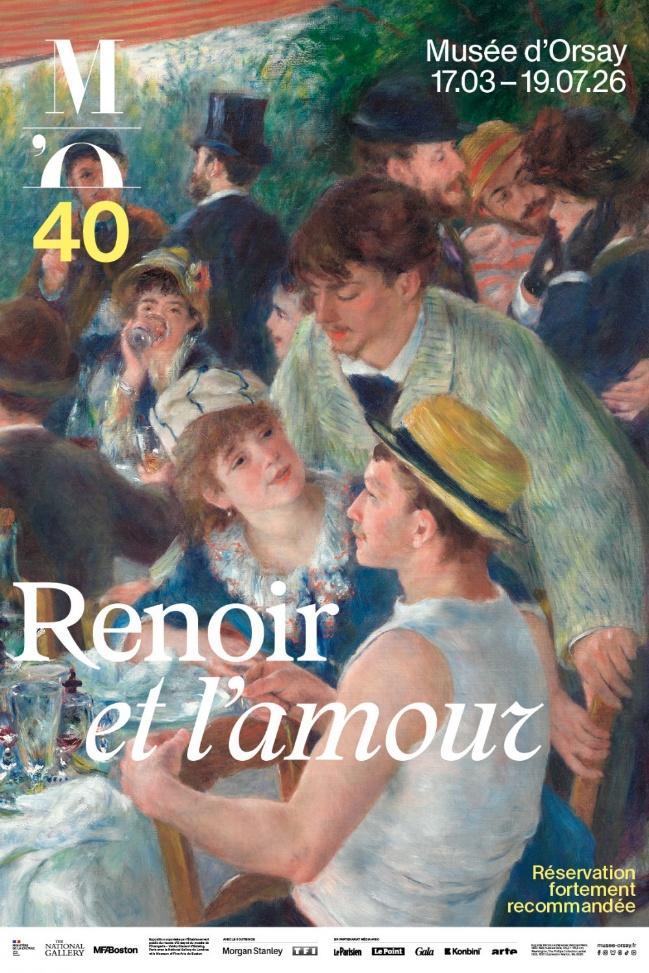
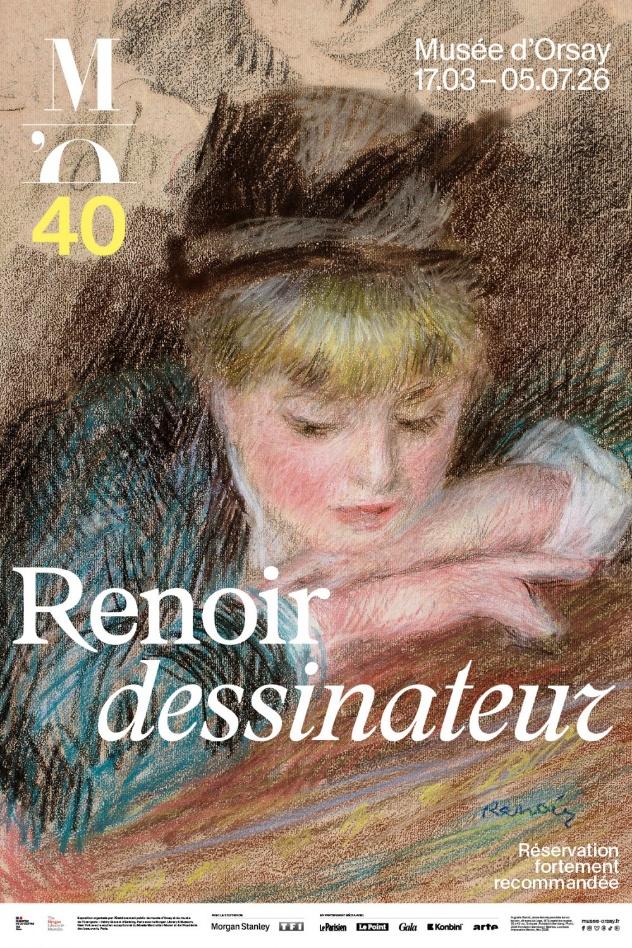
The exhibitions Renoir et l’amour. La modernité heureuse (1865-1885) and Renoir dessinateur, on show at the Musée d’Orsay until mid-July, offer an opportunity to look again at Proust’s Renoirs: which of the painter’s pictures did he know, and what part do they play in his own work? We know that he included “a Renoir” in the list of works which, in his view, could make up a “French Tribune” at the Louvre. In answering Jean-Louis Vaudoyer’s survey in this way in 1920, he did not say which picture he would choose: what mattered to him was that this painter’s art should be represented.
He had discovered Renoir’s work at the exhibitions organised in the 1890s by the dealer Paul Durand-Ruel, but also through private collections and through reproductions circulated in publications devoted to the Impressionists.
Proust turns to Renoir to formulate his definition of the original artist. In his view, such an artist acts like an ophthalmologist: he transforms our perception by re-creating the world. He imposes a new way of seeing it which alters our vision, for after seeing Renoir’s paintings, women, landscapes, light itself become “Renoirs”:
the original painter, the original artist proceed in the manner of oculists. The treatment by their painting, by their prose, is not always pleasant. When it is over, the practitioner tells us: “Now look.” And behold, the world (which was not created once, but as often as an original artist has come along) appears to us entirely different from the old one, yet perfectly clear. Women pass in the street, different from those of former days, since they are Renoirs, those Renoirs in which we once refused to see women. The carriages too are Renoirs, and the water, and the sky: we feel like walking in the forest that resembles the one which, on the first day, seemed to us anything but a forest, a tapestry, for instance, of many shades but lacking precisely the shades proper to forests. Such is the new and perishable universe that has just been created. It will last until the next geological catastrophe unleashed by a new original painter or writer. (Le Côté de Guermantes, RTP, II, 623)
Proust also invokes Renoir in his reflections on time: Renoir embodies the way in which the original artist becomes a classic, and illustrates the evolution of taste, which is always slow to recognise novelty. Proust recalls that it took many years for the painter to be hailed as a great artist, even as he describes his work as “perishable”.
Proust borrows from Renoir to create some of Elstir’s works, a sign of the painter’s importance in his own aesthetic. His Narrator questions the Duc de Guermantes about “a popular picture” in his Elstir collection: he wants to know the name of the figure depicted, a man in a top hat. By identifying him as one of the painter’s patrons, Proust alludes to Charles Ephrussi, editor of the Gazette des Beaux-Arts, whose collection included many Impressionist pictures. Ephrussi appears, standing with his back to us, in Luncheon of the Boating Party (1881), talking with his secretary, Jules Laforgue. In this scene devoted to the leisure of modern life, set at the Maison Fournaise in Chatou, Renoir brings together Alphonse, the owner’s son, and his sister Alphonsine, leaning on the balustrade, while Gustave Caillebotte, wearing a boater and sitting astride a chair, faces Aline Charigot, the painter’s future wife. In his answer to the Narrator, the Duc de Guermantes mocks Ephrussi’s status, dwelling on how incongruous his elegance looks in this setting of popular sociability on the banks of the Seine:
this gentleman is a sort of Maecenas for M. Elstir, who launched him and has often got him out of difficulties by ordering pictures from him. Out of gratitude – if you call that gratitude, it’s a matter of taste – he painted him in that place where, with his Sunday-best air, he looks rather comical. He may be a very learned pundit, but he obviously doesn’t know when one wears a top hat. With his, in the midst of all those bareheaded girls, he looks like a little provincial notary on a spree. (Le Côté de Guermantes, RTP, II, 790)
Renoir is clearly hidden behind this scene painted by Elstir, though Proust does not acknowledge it explicitly. Likewise, when his Narrator expresses the wish to go to the Musée du Luxembourg to see again the Plaisirs de la danse and Portrait de la famille X, which the Princesse de Guermantes has sold to it, he does not mention their kinship with Renoir’s works. Yet other allusions in À la recherche du temps perdu – notably to the portrait of Madame Georges Charpentier’s salon painted by Renoir in 1878, and to the painter’s attachment to Montmartre and the Moulin de la Galette – make it possible to identify the sources of the pictures attributed to Elstir. The one entitled Plaisirs de la danse arouses in the Narrator the fear that “certain lascivious poses might give Albertine a desire, a nostalgia for popular merrymaking, making her tell herself that perhaps a certain life which she had not led, a life of fireworks and open-air dance halls, had its good side.” (La Prisonnière, RTP, III, 905) He is troubled to see couples in the middle ground of the Bal du moulin de la Galette (illus. 1): in the centre, a lady in a pale dress puts her arm round her partner’s neck, while a man, on the right, has just kissed his dancing partner, whose cheeks are flushed.
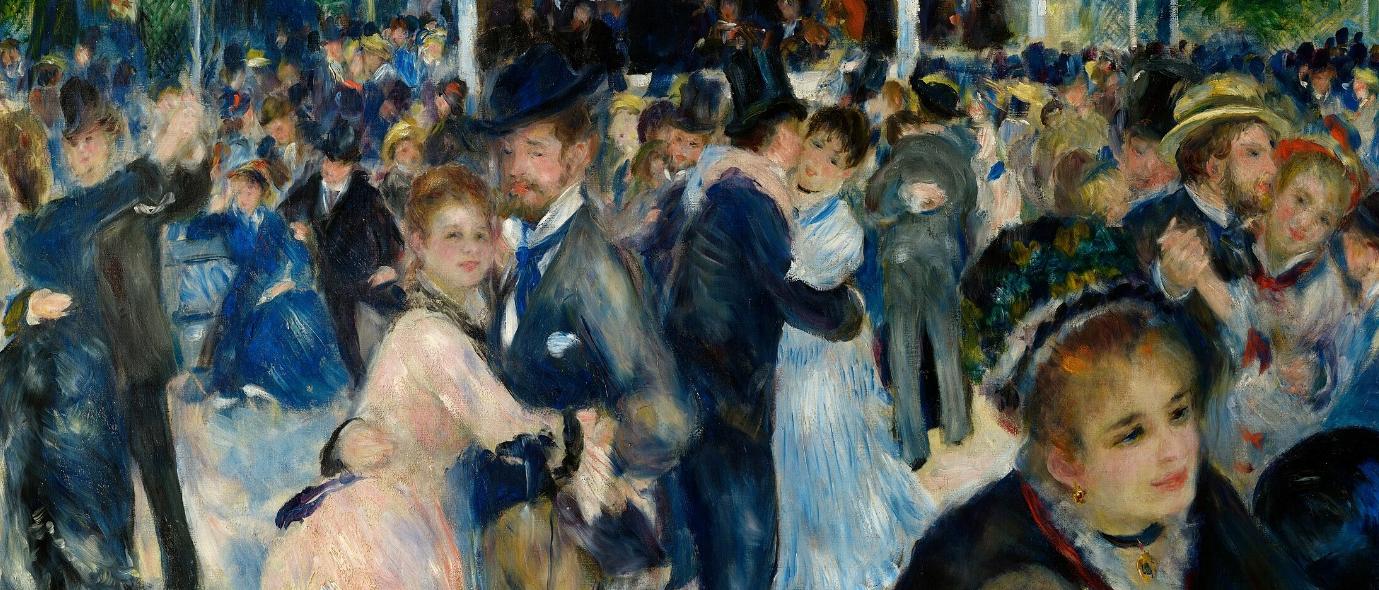
Illus. 1 – Bal du moulin de la Galette, 1876. Oil on canvas, 131.5 × 176.5 cm, Musée d’Orsay. © photo: RMN-Grand Palais; Mathieu Rabeau
The Narrator fears other pictures by Elstir even more:
“nudes of women in leafy southern landscapes which might make Albertine think of certain pleasures, although Elstir himself – but would she not debase the work? – had seen in them nothing but sculptural beauty, or rather the beauty of white monuments that women’s bodies take on when seated in greenery.” (La Prisonnière, RTP, III, 906)
In the course of his painful discovery of Albertine’s Gomorrhan tastes, the Narrator returns to these female figures, which clearly refer to Renoir’s Bathers series:
In one, one of the girls raises her foot as Albertine must have done when she offered it to the laundress. In the other she pushes the other girl into the water, who gaily resists, her thigh raised, her foot barely dipping into the blue water. I now remembered that the raised thigh made there the same swan’s-neck curve with the angle of the knee as the fall of Albertine’s thigh made when she lay beside me on the bed, and I had often wanted to tell her that she reminded me of those paintings. But I had not done so, so as not to awaken in her the image of naked women’s bodies. (Albertine disparue, RTP, IV, 108-109)
In tracing this lascivious line of the raised thigh, Proust links Elstir’s pictures to the works of Renoir’s Ingresque period. He no doubt saw The Large Bathers at Jacques-Émile Blanche’s, and may have seen, at least in reproduction, one of the many studies in red chalk and chalk for this series. (illus. 2)
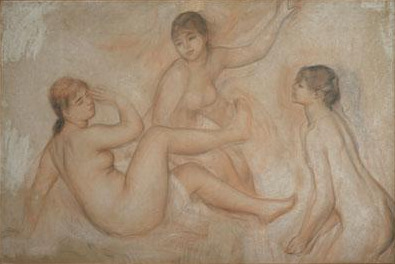
Illus. 2 – Three Bathers (study for The Bathers: Essay in Decorative Painting), c. 1886. Red chalk and black chalk heightened with white chalk on paper mounted on canvas, 108 × 162 cm, Musée d’Orsay, RF 29660. © photo: RMN-Grand Palais; Michel Urtado
With no intention of “debasing the work”, I chose Confidences (illus. 3) to illustrate the cover of the second volume of Sodome et Gomorrhe in the 1987 GF edition. This picture is now on show at the Musée d’Orsay, where one can also see La Loge (1874), which adorns the cover of Le Côté de Guermantes, edited by Élyane Dezon-Jones in the same series. Which picture would Proust have chosen had Vaudoyer asked him to specify his selection for the “French Tribune”? Let us keep this question in mind as we walk through the exhibitions, and linger, with Proust, before the Renoirs.
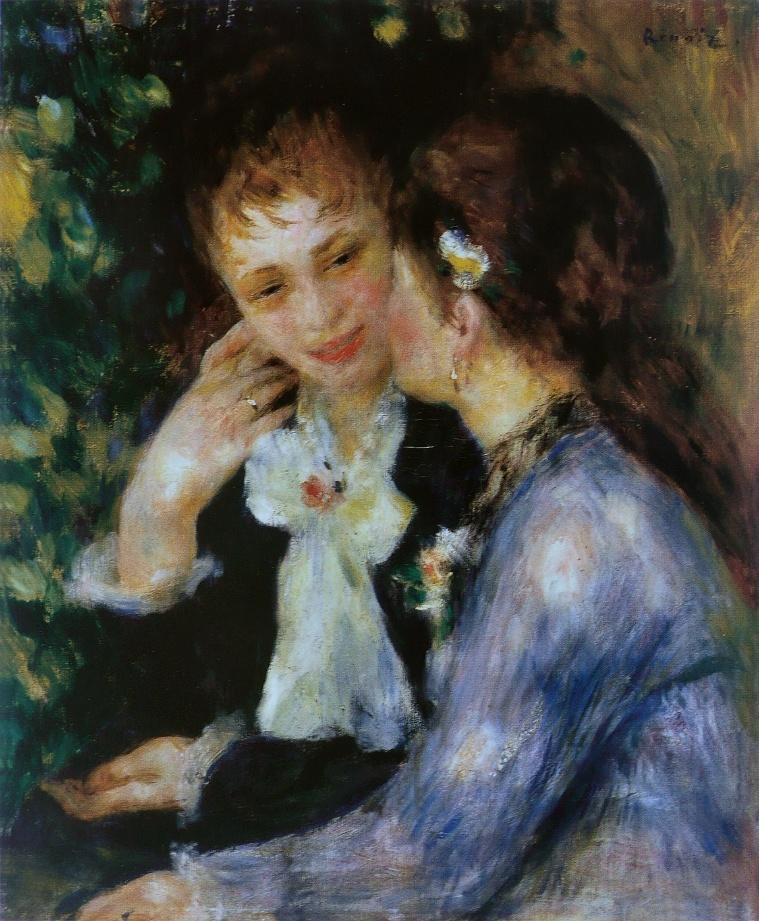
Illus. 3 – Confidences, 1878. Oil on canvas, 61.5 × 50.5 cm, Oskar Reinhart Collection, Winterthur1
Notes
1. https://upload.wikimedia.org/wikipedia/commons/6/62/Pierre-Auguste_Renoir_-_Confidences.jpg
