
by Emily Eells1
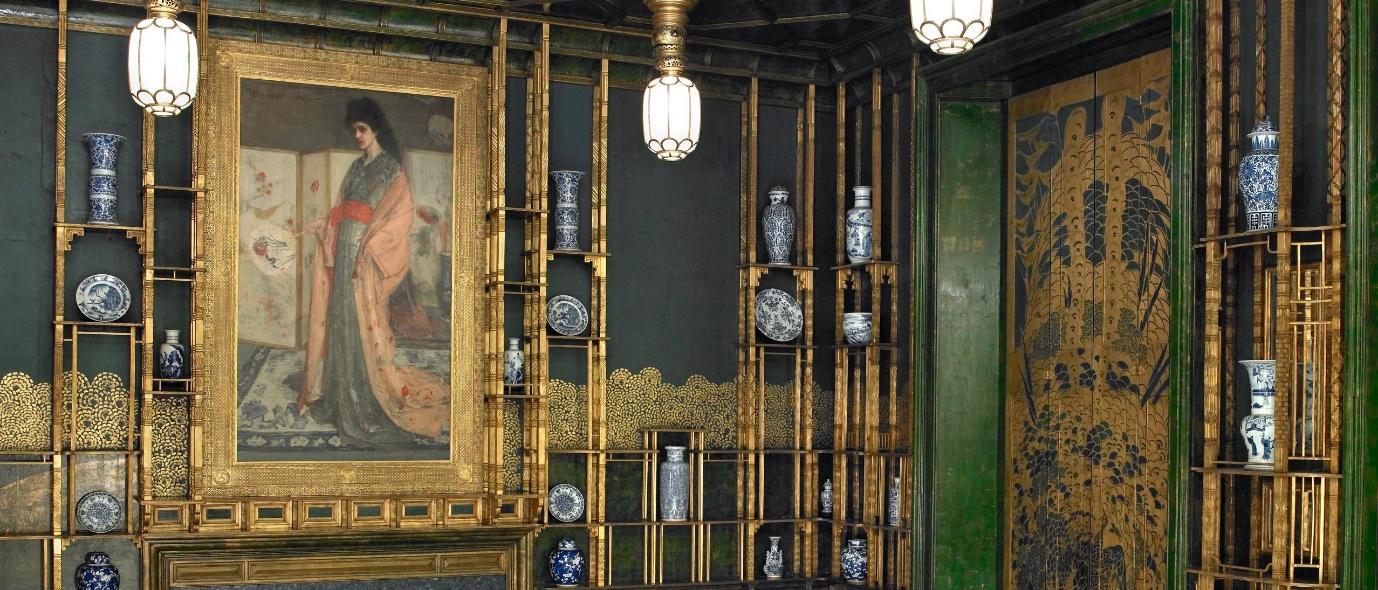
Whistler, Harmony in Blue and Gold: The Peacock Room (1876-1877), with Rose and Silver: The Princess from the Land of Porcelain (1863-1865), Freer Gallery of Art, Washington
The most important European exhibition devoted to Whistler in thirty years opened at Tate Britain in London at the end of May, bringing together many works that Proust knew. Among them is the first canvas by Whistler that he ever saw, Crepuscule in Flesh Colour and Green: Valparaiso (1866), that “quite exquisite seascape”, to quote what he wrote of it in his “Impressions des salons” of May 1891. There are also major paintings on which he commented, such as Arrangement in Grey and Black No. 1 – the famous portrait of Whistler’s mother – as well as the Nocturnes, which provoked John Ruskin’s wrath.
Proust met Whistler only once, in Méry Laurent’s salon, in 1895. From this meeting he kept the memory of a quip by the painter claiming that Ruskin knew absolutely nothing about painting. Proust nonetheless liked to recall that he had managed to make him “say a few good things about Ruskin!2” This attempt at reconciliation is all the more remarkable in that it came after the famous libel suit brought by Whistler against Ruskin in 1878, following the violent criticism the latter had levelled at his work.
An even more curious detail emerges from this memory: for some unknown reason, Proust left with a pair of pretty grey gloves belonging to Whistler, now lost. They must have resembled those worn by Robert de Montesquiou in the portrait Whistler painted of him, chinchilla cape over his arm and cane in hand, ready to go out into society or just back home. Proust had this portrait in mind when he described the Baron de Charlus at the Princesse de Guermantes’s as a “Whistler ‘Harmony’ in black and white; black, white and red rather, for M. de Charlus was wearing, hanging from a broad ribbon on the jabot of his evening coat, the white, black and red enamel cross of a Knight of the religious Order of Malta.3”
Proust visited the great retrospective devoted to Whistler, who died in 1903, held in London in 1904 before being shown, in June 1905, at the École des Beaux-Arts in Paris. He went there on 15 June, the very day La Renaissance latine published Jacques-Émile Blanche’s review of it. He pointed it out to several of his correspondents, not only because of the importance he attached to the exhibition, but also because the same issue carried his own text, “Sur la lecture”, which he later used as the preface to his translation of John Ruskin’s Sesame and Lilies. From the outset, Proust distanced himself from Blanche and from most French critics of his day, who were generally reserved about Whistler. In a letter to Marie Nordlinger, he observes that “there is at the moment, among the artistic elite of France, a terrible reversal of opinion about Wisthler [sic]. He is considered a man of exquisite taste who was thereby able to make people believe he was a great painter although he is nothing of the sort. Jacques Blanche in the Renaissance latine […] has basically expressed the same opinion with more fairness and even fervour. It is not mine at all.” In a letter to Anna de Noailles, Proust judges Blanche to be “a little cruel” towards Whistler, even though he would later agree to write the preface to Blanche’s collection Propos de peintre, which includes a revised version of this article.
The current exhibition at Tate Britain seems to prove Proust right, he who did not hesitate to take the opposite view to his contemporaries when he wrote: “If the man who painted the Venices in turquoise, the Amsterdams in topaz, the Brittanys in opal, the painter of the room with curtains strewn with bouquets of roses and above all the sails in the night […] is not a great painter, one might think there never was one.”
Proust expressed the keen interest that the Whistler exhibition aroused in him in a letter to his mother, accompanied by a detailed plan showing her the pictures that had particularly caught his attention. Until recently, only the rough sketch published by Philip Kolb in the Correspondance générale to illustrate the letter of 15 June 1905 was known. Having listed the works he liked, Proust ends with this exclamation: “I am forgetting almost everything.”
The annotated plan intended to guide his mother bears witness to the enthusiasm with which Proust went round the exhibition. On it he noted the works she must not miss, punctuating his recommendations with the repeated injunction “you look, you look”, while the right-hand margin is overrun by an “etc. etc. etc.” written out several times. This document, part of the important acquisition of manuscripts that has recently enriched the Proust holdings of the Bibliothèque nationale de France, makes it possible to determine more precisely which of Whistler’s works he wished to point out to his mother.
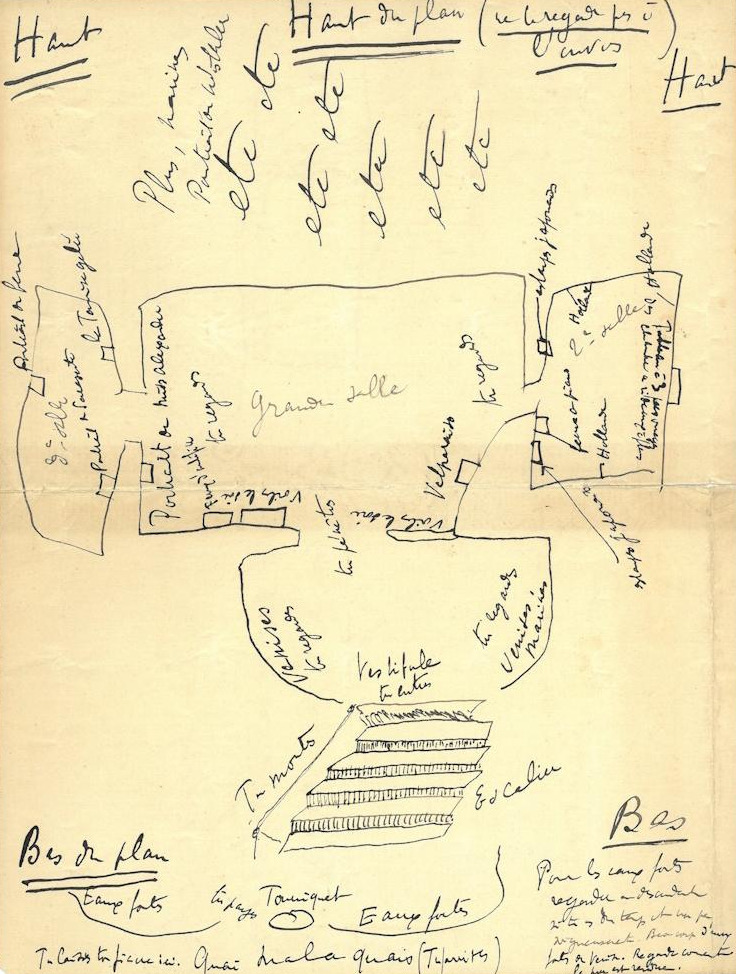
Proust: Plan of the Whistler exhibition at the École des Beaux-Arts, Paris, May 1905.
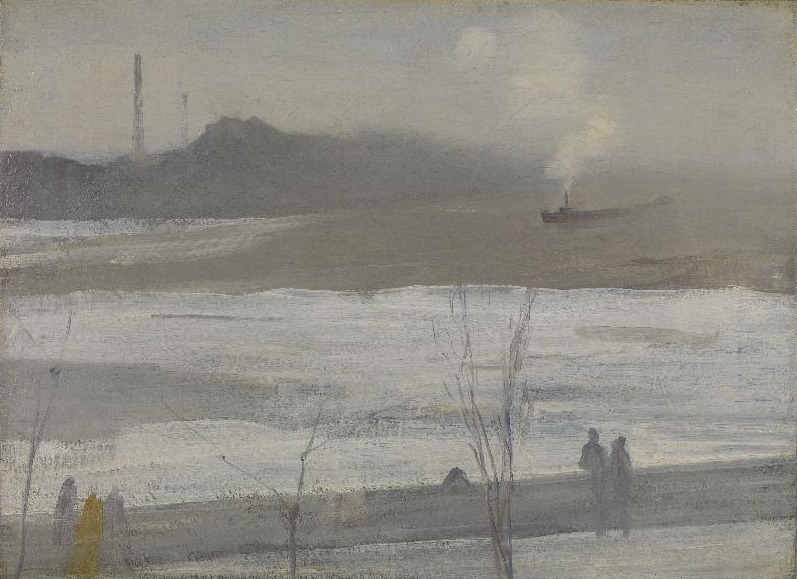
Whistler, Chelsea in Ice (1864), Colby College Museum of Art
The exhibition at Tate Britain, on until the end of September, offers an opportunity to see many of them again. It also brings to light works that one is tempted to compare with Elstir’s pictures. Such is the case of Chelsea in Ice, another version of Thames in Ice, whose title Proust had noted on the plan for his mother. Something of the Port de Carquethuit can be found in this winter landscape, in which every boundary between land and river, bank and ice floe, fades away.
The staging at Tate Britain creates several immersive spaces. At the entrance, visitors are greeted by The Artist in His Studio, a picture that brings together several of Whistler’s favourite themes: the self-portrait of the painter at work, inspired by Velázquez’s Las Meninas, the Japonisme embodied by the woman in a kimono holding a fan, and a subtle play of reflections and mises en abyme created by the mirror and the frames hanging on the wall.
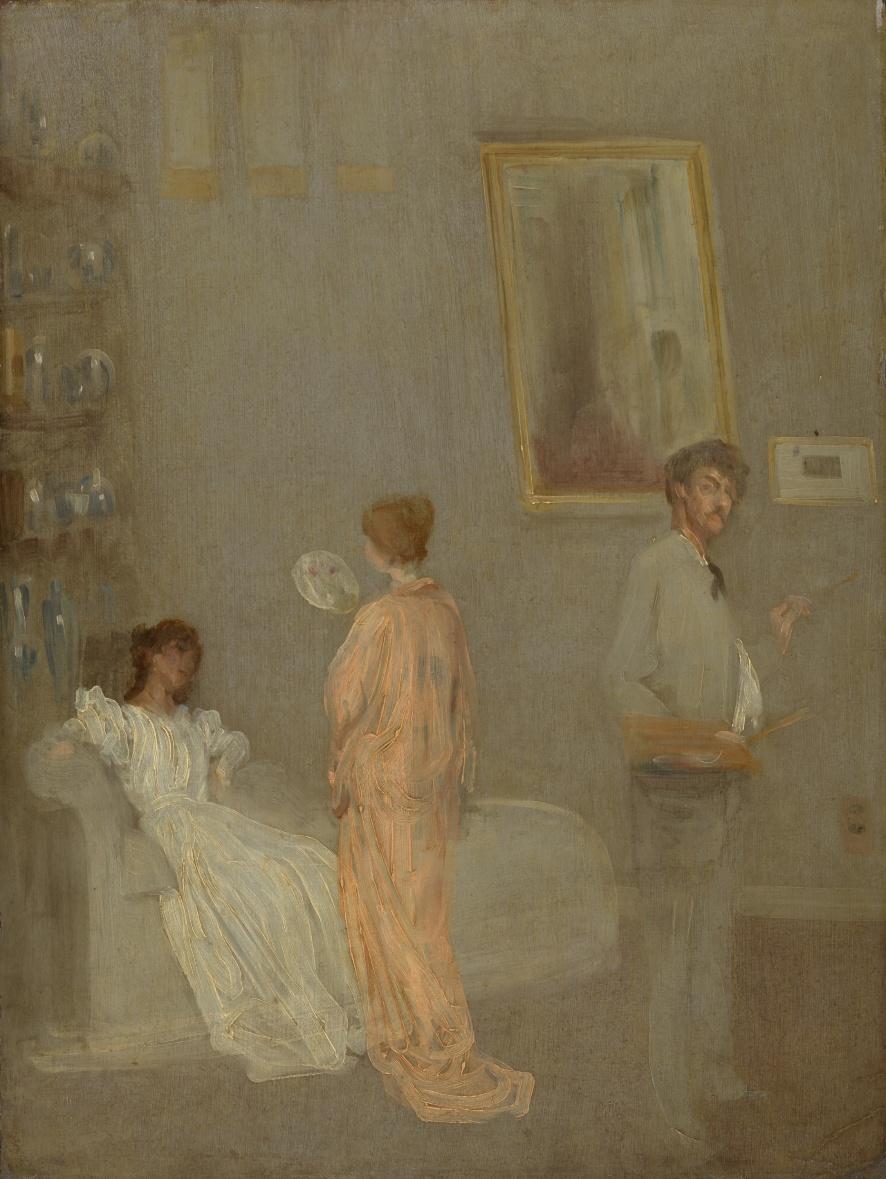
Whistler, The Artist in His Studio (1865-1866), Art Institute of Chicago
In this first self-portrait of the exhibition, Whistler looks at us through his monocle with perfectly self-assured confidence. The route is punctuated by others that reveal how carefully the artist cultivated his image – a form of self-fashioning, to use a term now in common use. While the Portrait of Whistler with Hat (1857-1858), which Proust had seen in 1905, is not on show, another early portrait (1856-1860), shown in London for the first time since the painter’s death, depicts him in a boater, cigarette in hand, blowing out a puff of smoke with all the nonchalance of a dandy.
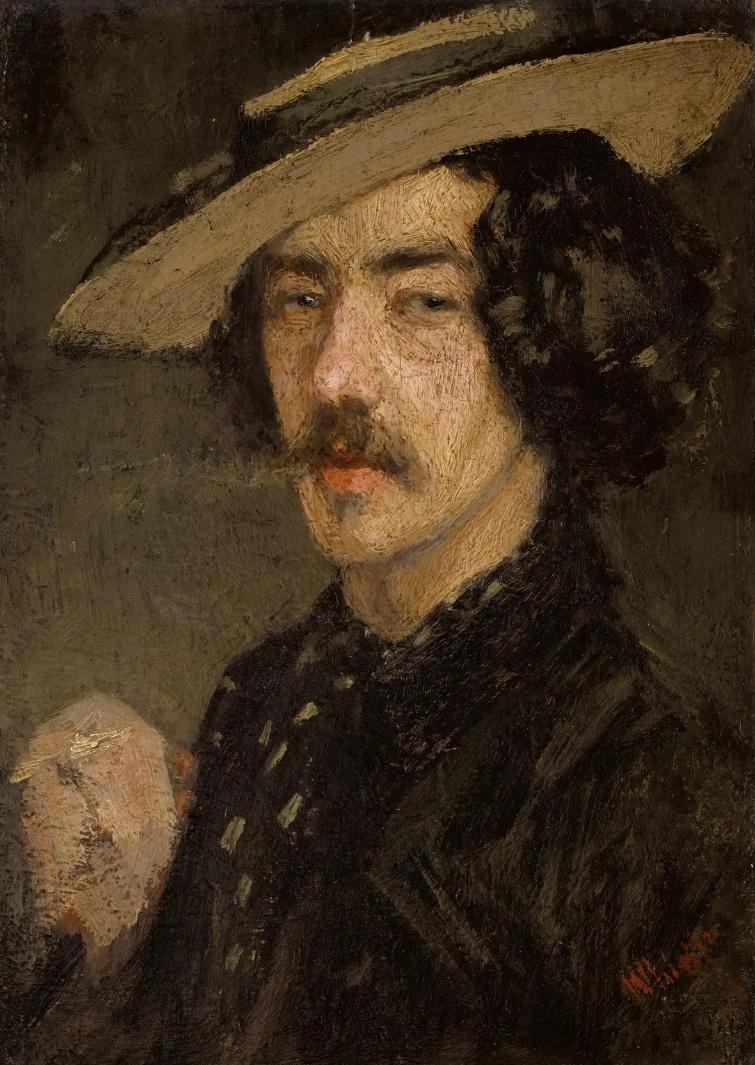
Whistler, Self-Portrait (1856-1860), private collection
Two self-portraits the artist painted towards the end of his life, placed on either side of the exit, draw on Rembrandt’s poses and palette. In the picture entitled Gold and Brown: Self-Portrait (c. 1895-1900, Smithsonian American Art Museum), a small red dot reveals an artist who has now arrived, proud to wear his Legion of Honour. In his article on Whistler, Jacques-Émile Blanche paints the portrait of a “devil of a man, noisy in public, boastful, childishly vain”, endowed with a “biting wit, mixed with a great deal of impertinence.” It is easy to understand how this provocative personality could exasperate Ruskin, already irritated by what he called the “Cockney impudence” with which Whistler had, in his famous phrase, “flung a pot of paint in the public’s face”. Accusing the critic of libel, the painter brought against him the famous lawsuit of 1878, which he won, but at the cost of serious financial difficulties.
The curators of the exhibition have devoted a room to this more combative side of Whistler. Arranged as a lecture hall, it plays a recording – or rather the reconstruction of a deliberately hammy performance – of the lecture entitled Ten O’Clock. Dressed in evening clothes, the painter set out in it, in 1885, the principles of his aesthetic and returned to his quarrel with Ruskin. Proust has Jean Santeuil tell the King of Portugal about this lawsuit, without telling us any more about it4.
The display cases include, among other things, a copy of the Ten O’Clock, the “delightful little book on Whistler” of which Marie Nordlinger sent Proust the 1888 English edition at the beginning of 1905. There is also a copy of The Gentle Art of Making Enemies, the collection in which Whistler gathered his polemical writings and his version of the conflict with Ruskin. The book is decorated with a butterfly, that “favourite signature of the master of Chelsea” mentioned by Proust (RTP, II, p. 163). Reproduced on the binding as on the title page, the graceful insect has a sting at the end of its tail, as if to announce the barbs Whistler fires at his adversaries.
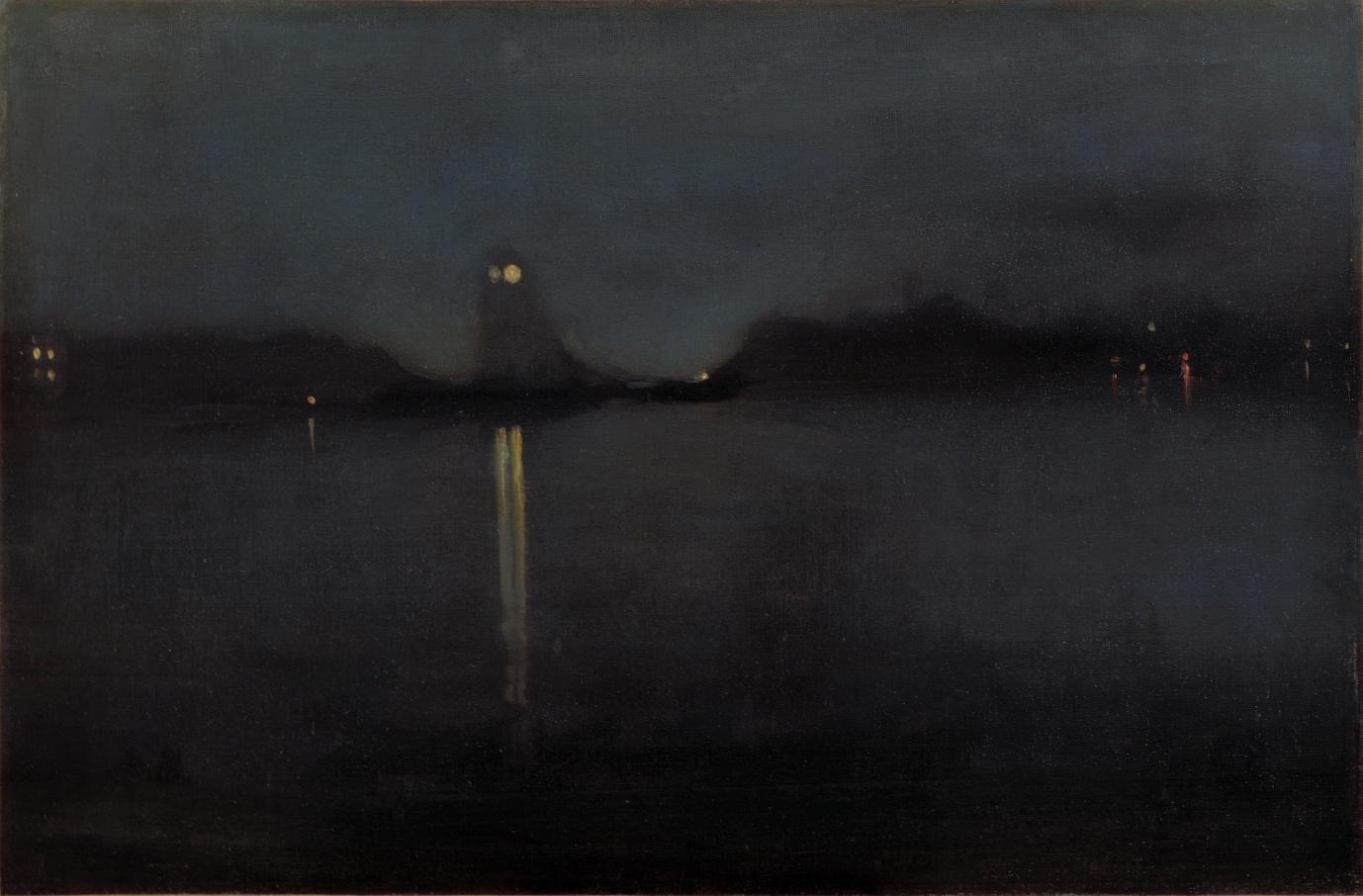
Whistler, Nocturne (1875-1878), White House, Washington
The picture that sparked the controversy with Ruskin, Nocturne in Black and Gold: The Falling Rocket, belongs to the series of views of London painted in the 1870s that Whistler called “Nocturnes”, following a suggestion by his patron Frederick Leyland. Several of them can be admired at the Tate exhibition. The Nocturne of 1875-1878, lent by the White House, shows the lights of a factory chimney reflected in the Thames until it takes on the appearance of a campanile. The label sees in it an illustration of the ideas developed in the Ten O’Clock, according to which the artist is able to transfigure the modern world into a work of art. Proust had this text in mind when, in Le Côté de Guermantes, he has Charlus say that there comes the “moment when, as Whistler says, the bourgeois go home […] and when one ought to begin to look” (RTP, II, p. 852). Here is the passage to which this remark alludes, in Whistler’s own words:
And when the evening mist clothes the riverside with poetry, as with a veil, and the poor buildings lose themselves in the dim sky, and the tall chimneys become campanili, and the warehouses are palaces in the night, and the whole city hangs in the heavens, and fairy-land is before us – then the wayfarer hastens home; the working man and the cultured one, the wise man and the one of pleasure, cease to understand, as they have ceased to see, and Nature, who, for once, has sung in tune, sings her exquisite song to the artist alone, her son and her master – her son in that he loves her, her master in that he knows her.
The exhibition has also reconstructed the dining room that Leyland had commissioned Whistler to decorate (see illustration above). As the project turned out to be far more costly than planned, a quarrel broke out between the artist and his patron. If Whistler had emerged penniless from his lawsuit against Ruskin, this time it was Leyland, too, who lost his feathers. The two adversaries reappear as peacocks fighting over gold coins: with Whistler, even the settling of scores has panache. With Harmony in Blue and Gold: The Peacock Room, Whistler created an interior entirely steeped in Japonisme, conceived as the setting for Rose and Silver: The Princess from the Land of Porcelain. The picture shows a young woman in a kimono in front of a Japanese screen, holding an uchiwa – a flat fan that does not fold – while Leyland’s collection of blue-and-white porcelain is arranged on the shelves around the room. The whole forms one of those “tasteful arrangements” steeped in Japonisme that Proust attributes to Elstir in a preparatory draft of the Recherche. In Notebook 28, he thus describes a woman standing in front of a flowered screen, whose dress extends “in an endless train that seemed laid along the length of the room like a carpet of flowers”, so that “the whole seemed one and the same mosaic of figures and Japanese flowers”. The eye “could not tell the living flowers from the silk flowers, nor the woman of flesh from the porcelain women5.” Rose and Silver: The Princess from the Land of Porcelain reigns among the “Japanese-print sort of things” that Proust had pointed out to his mother. The Tate exhibition strongly highlights Whistler’s Japonisme, which did much for his reputation in Britain. From The Artist in His Studio, the first picture on the route, Japanese scrolls can be seen hanging on the wall next to shelves laden with porcelain, testifying to the painter’s passion for the art of the Far East.
Whistler’s Japonisme is literally at the centre of the first room of the exhibition, thanks to a replica of the large screen the painter made in collaboration with the Japanese artist Nampo Jhoshi. She painted birds and flowers on it in an oriental style, while Whistler depicted on the reverse one of his favourite motifs: Battersea Bridge in a nocturne bathed in moonlight. A collector of prints by Utagawa Hiroshige and Katsushika Hokusai, among others, Whistler drew extensively on Japanese art, as Proust’s Elstir would do, who was “for a long time impressed by Japanese art” (RTP, II, p. 424). At the Tate we learn that, to paint Variations in Flesh Colour and Green: The Balcony, which Proust saw at the 1905 exhibition, Whistler drew on a print from his own collection: Shigatsu, the fourth in the series “Twelve Months in the South” created by Torii Kiyonaga in the 1780s. The first picture signed with the famous butterfly, The Balcony sets a Japanese-style foreground – cherry trees, fan, kimonos and a sake bottle on a lacquered tray – against a background dominated by the industrial wharves of the Thames. The silhouettes of factories, the smoking chimneys and even two heaps of industrial waste trace a shape there that evokes Mount Fuji.
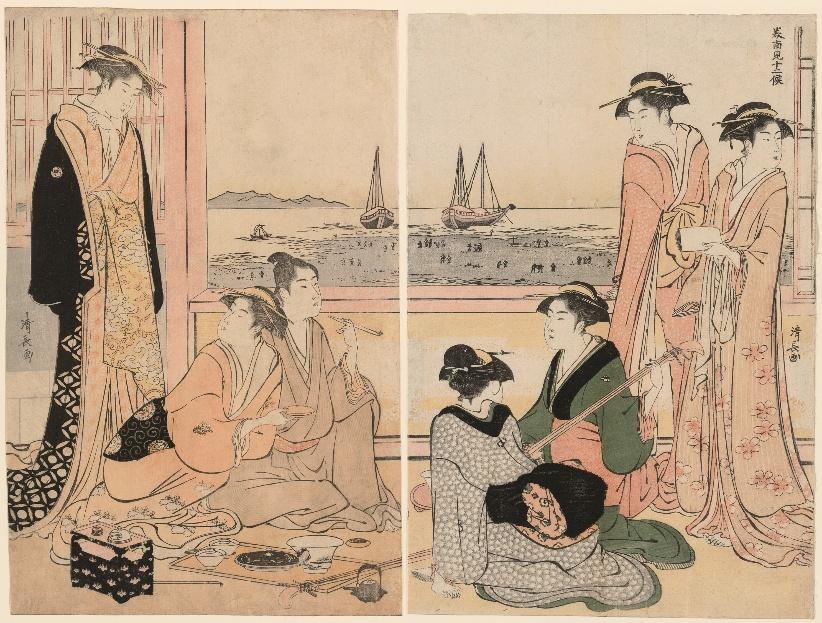
Torii Kiyonaga, Shigatsu (c. 1780), Art Institute of Chicago
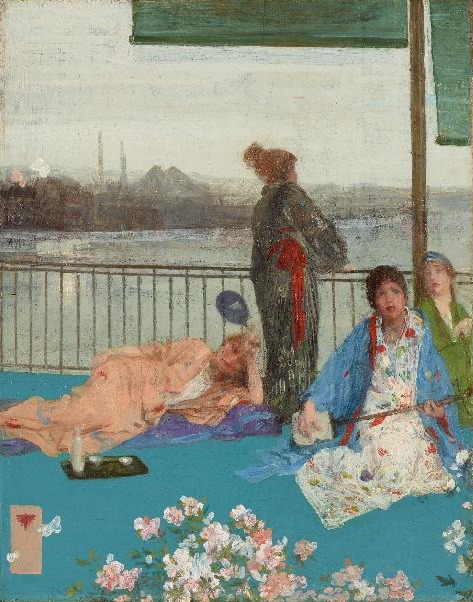
Whistler, Variations in Flesh Colour and Green: The Balcony (1864-1870), Smithsonian, Washington
Proust found Blanche too severe towards Whistler, particularly regarding his etchings, which “do not seem [to him] worthy of their reputation”: he even finds the first ones “weak”. The Tate exhibition shows a great many that belie this judgement. Proust, for his part, had liked them, and had drawn his mother’s attention to several of them. On the plan he drew for her, he returns three times to the views of Venice, advising her to look “rather carefully at a lot of etchings of Venice. Look at how the sea is rendered”.
Indeed, the sea is often barely suggested in them: a few lines are enough to evoke its presence, as if it were rising to the surface of the paper. With the same delicacy, Whistler “renders” the waters of the canals of Venice, Amsterdam or the Thames.
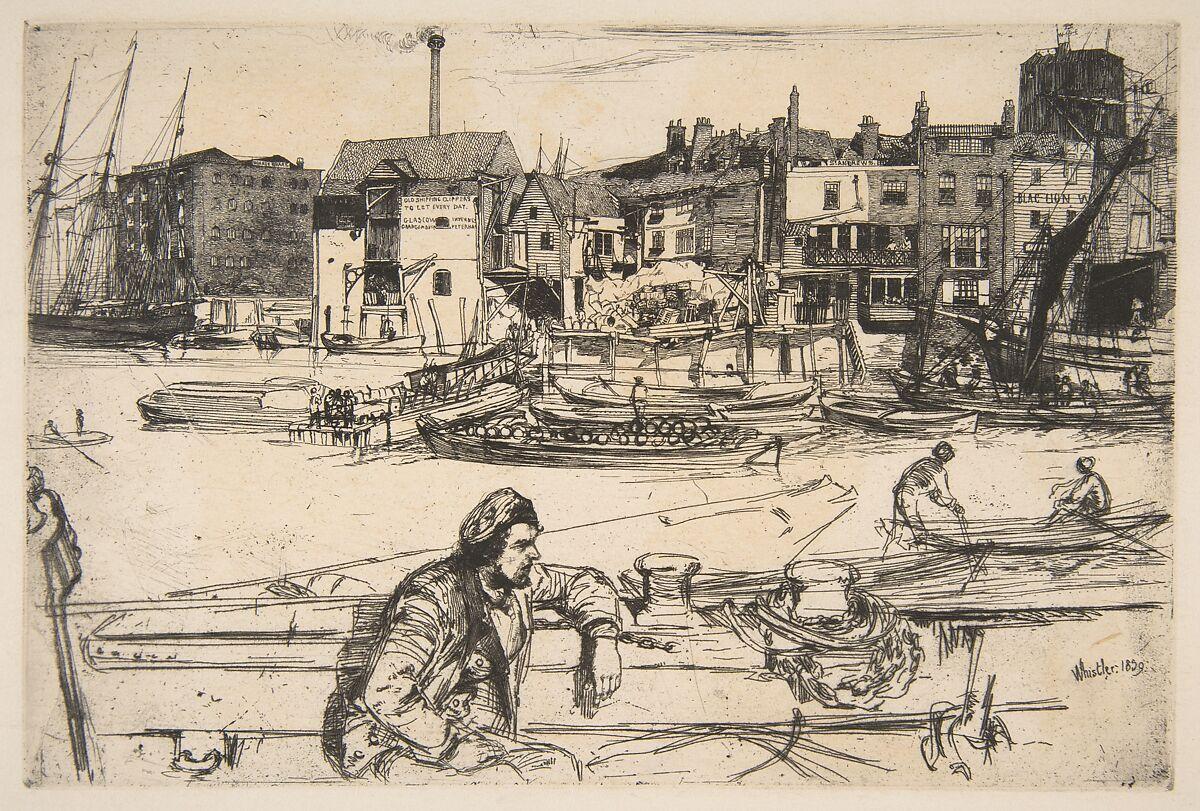
Whistler, Black Lion Wharf (1859), Metropolitan Museum of Art, New York
The first London etchings, made shortly after Whistler arrived in England at the end of the 1850s, already reveal his exceptional mastery of the medium. In Black Lion Wharf he depicts the docks, experimenting with daring framings and divisions of space that recall Japanese prints. He also borrows certain effects from photography: the distant warehouses are rendered with remarkable precision – one can even read the names painted on their façades – while the forms in the foreground are treated more freely and synthetically. Proust was able to examine this etching closely at the 1905 exhibition; he would no doubt have had more difficulty recognising it in the black frame hanging on the wall behind Whistler’s mother in Arrangement in Grey and Black No. 1, where it appears in a deliberately blurred form, even though the original is distinguished by the extraordinary precision of its line.
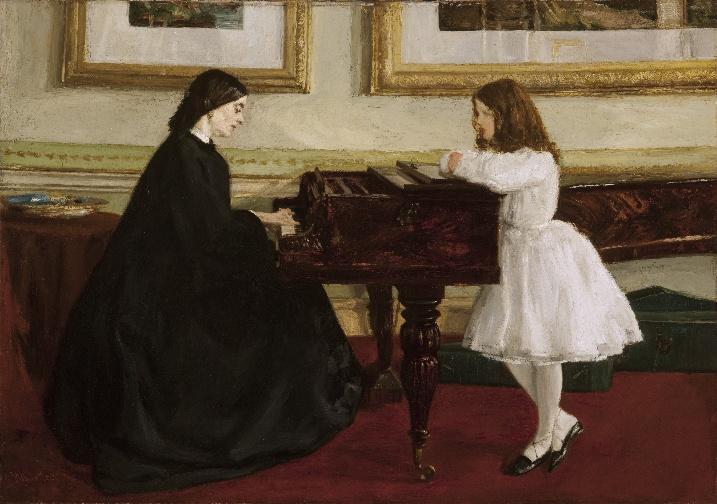
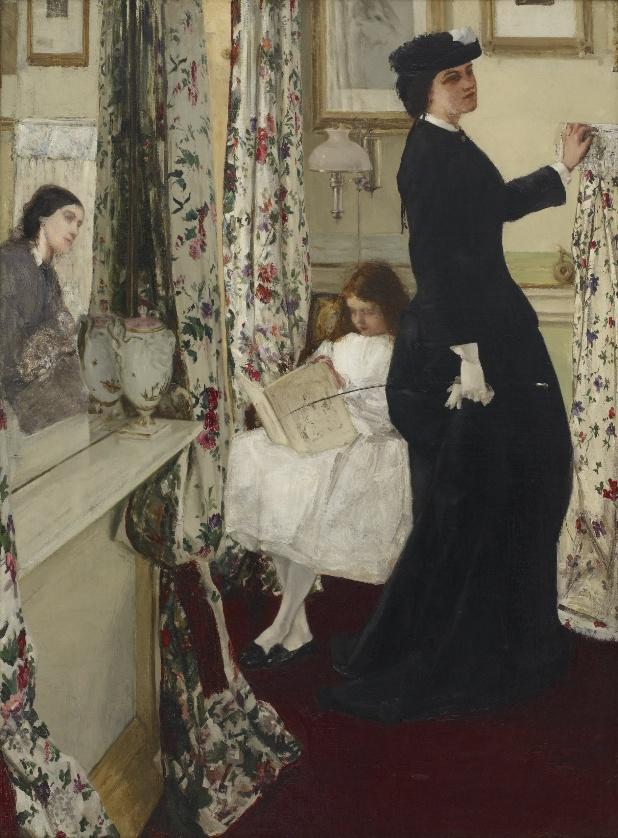
Whistler, At the Piano (1858-1859), Taft Museum of Art; Whistler, Harmony in Green and Rose: The Music Room (1860-1861), Smithsonian
In At the Piano, the glass of the frames hanging on the wall reflects other pictures placed opposite them, behind the viewer. This mise en abyme contributes to the depth of the scene, as does the arrangement of the two figures: Deborah Haden, Whistler’s half-sister, dressed in black, and her daughter Annie, in white, listening to her play the piano. They form two focal points that give the impression, on the principle of stereoscopic photography, that the field of vision opens up and deepens. Shown in 1905 opposite Harmony in Green and Rose: The Music Room, the canvas holds a dialogue with this other interior scene. In it Annie sits reading while her mother’s face, still at the keyboard, is reflected in a mirror. Proust particularly recommended this picture to his mother, advising her in his letter to look at “a room with light curtains and three figures” and specifying on his plan that the curtains were flowered. The frames on the wall, the reflections and the sharply angled perspective produce a paradoxical effect: they suggest depth while compressing space. In keeping with its original title, The Morning Call, an elegant horsewoman has come to pay a visit. She has taken off one glove, while her other hand remains gloved. This pair of white gloves, standing out against the black of her dress, discreetly introduces the presence of the outside world into this refined interior.
Whistler often uses gloves as an eloquent accessory, a sign of social distinction and elegance, as we saw in his portrait of Count Robert de Montesquiou-Fezensac. Among the works Proust pointed out to his mother is a “large portrait of a woman”, no doubt a full-length portrait, but as he does not give the sitter’s name it is impossible to identify it with certainty. On the other hand, he mentions “Miss Alexander”, one of the daughters of William C. Alexander, a London banker and collector who shared Whistler’s passion for Japanese art. A visit to the Tate exhibition nevertheless prompts the question: which of the two Miss Alexanders was Proust referring to? Proust scholars have generally favoured the one the 1905 catalogue calls “Miss C. H. Alexander”, shown holding her hat at knee height in a pose reminiscent of Velázquez’s Las Meninas, enhanced with discreet Japanese touches. Yet the London exhibition shows, opposite her, the portrait of her elder sister, May Alexander, whom the same catalogue simply calls “Miss Alexander” – and that is indeed how Proust names her. Admittedly, the picture is less appealing at first sight: left unfinished, it is dominated by dark tones. Yet the gesture of May, busy buttoning her gloves, subtly animates the composition, creating a moment of transition, an in-between state between inside and outside.
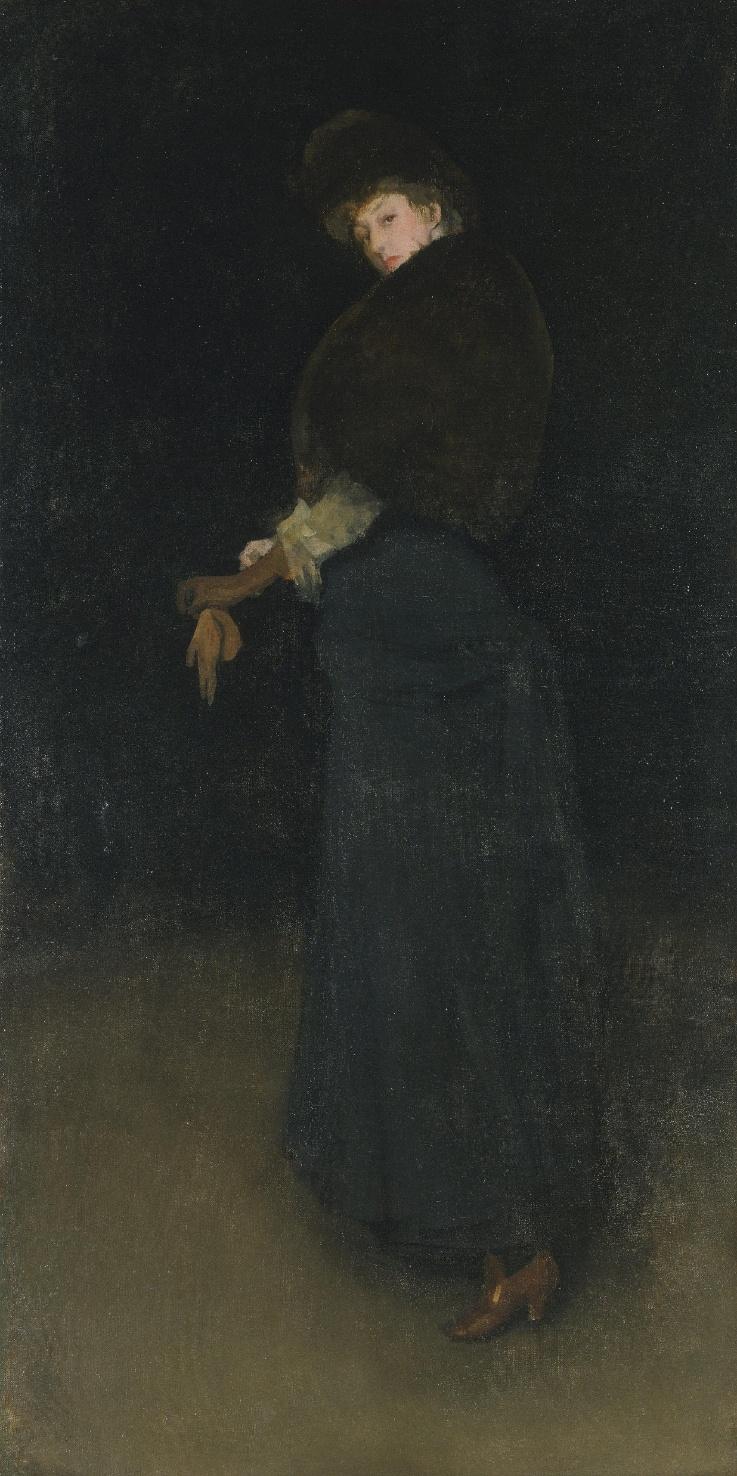
Whistler, Arrangement in Black: Lady in the Yellow Buskin (1882-1885), Philadelphia Museum of Art
The same is true of Arrangement in Black: Lady in the Yellow Buskin, hung opposite the exit door of the Tate exhibition. Whistler shows Lady Archibald Campbell buttoning her yellow glove. Turning her head over her shoulder, she seems to invite the viewer to follow her into the night, not without evoking the enigmatic female silhouettes that people the streets of fin-de-siècle London. This fleeting apparition can be seen again in London, where the exhibition runs until the end of September, before travelling to the Van Gogh Museum in Amsterdam under the title Whistler. Dandy and Disruptor, while the Mesdag Collection in The Hague will simultaneously hold Whistler: Loving the Netherlands from October 2026 to January 2027. This last exhibition will give pride of place to the Dutch views that Proust particularly admired, he who counted the “Amsterdams in topaz” among Whistler’s finest works.
Notes
1. I am most grateful to Élyane Dezon-Jones for her careful reading of this article.
2. All quotations from Marcel Proust’s Correspondance in this article come from letters written in 1905 and are taken from volume V, edited by Philip Kolb in 1979.
3. RTP, III, pp. 52-53. The abbreviation RTP is used here for references to the edition of À la recherche du temps perdu published under the direction of Jean-Yves Tadié by Gallimard (1987-1989).
4. Jean Santeuil (Gallimard, 1971), p. 682.
5. Notebook 28, N.A.Fr. 16668, fol. 7 r°-8 r°.