
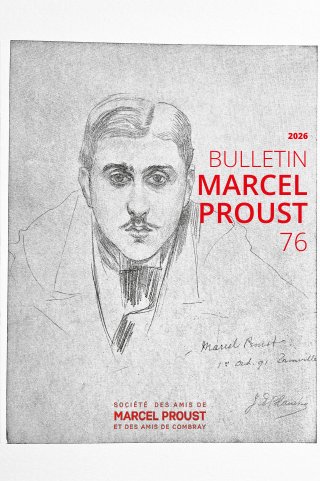
The Bulletin Marcel Proust no. 76 (2026) has been published. We publish here the opening of each of its texts. Members whose subscription is up to date can read it in full in the Members’ Area, as a PDF and in a web version, in French and in ten other languages.
Contents
Opening remarks
A word from the President — Jérôme Bastianelli p. 13
A word from the editor — Isabelle Serça p. 17
Unpublished text
Two visiting cards to Robert de La Sizeranne rediscovered at the Harry Ransom Center (University of Texas at Austin) — François Proulx and Nina Kirkegaard p. 21
Articles
A source of the narrator’s medieval reveries: Camille Enlart’s Manuel d’archéologie française — Thierry Laget p. 31
Sargent and Proust’s world — Emily Eells p. 39
Proust and the revolutionary left — Max McGuinness p. 57
A confession that never was — Tristan Macé p. 81
“Little madeleines” for Marcel Proust — Jalel El-Gharbi p. 103
If It Die… self-sacrifice in Proust and Gide — Kentaro Oshima p. 109
Marcel Proust, military registration number 263 — Pascal Pfister p. 123
From Wagner to Vinteuil: the redistribution of the musical reference in the scene of the grandmother’s death — Maria Medda p. 127
Carpets for Albertine: “Gustave Fayet at Marcel Proust’s” — Cécile Leblanc p. 149
Testimonies and recollections
From Proust to Céleste — Jason Weiss – Photos by Séamas McSwiney p. 159
Céleste unvarnished: the rediscovered interview — Laure Hillerin – Photos by Séamas McSwiney p. 163
On Édouard Béchet’s Souvenirs — Stéphane Brouillaud p. 177
Extract from the “Souvenirs” of Édouard Béchet (1863-1947), written in 1935 p. 179
Tribute to Guy Cogeval, the most Proustian of museum directors — Guillaume Cerutti p. 187
Reviews
Marcel Proust: Cent lettres inédites, Correspondance retrouvée 1886-1922 — Thierry Laget p. 192
Geneviève Henrot Sostero: Le « Tiers Monde » d’À la recherche du temps perdu. Pour une poétique du figurant proustien — Pascal A. Ifri p. 195
Max McGuinness & Michael Cronin: The Irish Proust: Cultural Crossings from Beckett to McGahern — Élyane Dezon-Jones p. 198
Bulletin d’informations proustiennes no. 56 — Pascal A. Ifri p. 200
Yasué Kato and François Proulx: Sur les traces de Ruskin. Voyages, réception et sources proustiennes — Jean-Marc Quaranta p. 203
Christophe Pradeau, Jessica Desclaux and Théo Millot: Albert Thibaudet. Une cité des livres — Davide Vago p. 205
Sofia Sandreschi de Robertis: Proust e l’abitudine. Identità, memoria, inconscio — Ludovico Monaci p. 209
Louis de Robert: Le Roman du malade — Jean-Marc Quaranta p. 213
Thierry Laget: Proust en soutane — Nicolas Ragonneau p. 216
Christophe Grandemange: Lucien Daudet. Un amour de Proust — François Proulx p. 217
Renaud Meyer: Retour à Balbec — William C. Carter p. 219
Brigitte Albert-Jacouty and Marianne Brody-Baudin: L’Affaire Stermaria — Emily Eells p. 221
Books received
Books received p. 226
Collections news
Museum acquisitions — Anne Imbert p. 231
A painting by Jean Béraud at the Musée Marcel Proust! — Anne Imbert p. 235
Society news
Interview with Laurent Mauvignier — Jérôme Bastianelli p. 240
The Maison de Tante Léonie put to the test by its visitors: a reading of the visitors’ book — Jérôme Bastianelli p. 255
Annual report 2025 — Anne Imbert, Secretary General unpaginated
Financial report — Éric Unger p. 261
Acknowledgements p. 271
Proustian pastiche competition — Alexandra de Léal p. 273
Obituaries
François-Bernard Michel p. 288
Nicolas Grimaldi p. 290
Jacques Dubois p. 292
Claude Térouinard p. 297
Appendices
Practical information p. 300
Picture credits p. 303
The opening of each text
Opening remarks
A word from the President
Jérôme Bastianelli · p. 13–16
“This peaceful studio with its rural horizon had been filled with a delicious surplus, as happens in a house where a child was already enjoying himself and where he learns that, in addition, through the generosity with which beautiful things and noble people endlessly increase their gifts, a magnificent tea is being prepared for him.”
Marcel Proust, À l’ombre des jeunes filles en fleurs
Two years have already passed since the reopening of the Maison de Tante Léonie. After the time of the building works, and then that of our reunion with a place profoundly transformed and yet still itself, has come the time we had been hoping for: the time of a House fully alive.
Bringing it to life means, of course, continuing to welcome thousands of visitors there every year, but also multiplying the occasions to return. It is in this spirit that this year we inaugurated a new series of talks: “Goncourt Prizewinners as Guests of Tante Léonie”. The connection almost suggested itself, so closely has the name of the prize remained bound up with Proust’s story since December 1919 and the award to À l’ombre des jeunes filles en fleurs. Laurent Mauvignier and Pierre Lemaitre opened the series, which we shall have the pleasure of continuing on 10 April next with Mathias Énard, and with others besides. We naturally hope to welcome many former laureates in the years to come: there is something heartening in seeing the great […]
Opening remarks
A word from the editor
Isabelle Serça · p. 17–20
This year we are inaugurating a new era since, at the request of many of you, the Bulletin Marcel Proust is available in a print version and in a digital version: the choice is yours – or opt for both! This leap into modernity comes with a website entirely and masterfully redesigned by our treasurer Éric Unger: we leave you the pleasure of browsing these web pages and discovering a new way of reading the Recherche, which is set to attract enthusiasts from all over the world. As for the traditional edition, it is worth noting that Proust is returning to his typographical home ground, so to speak, since the Bulletin is printed in the Mayenne, where Du côté de chez Swann was printed.
The sections, for their part, remain unchanged. You will find unpublished texts (letters discovered in an American library), followed by articles that bring Proust’s work into dialogue with other arts, such as music (“From Wagner to Vinteuil”) or painting (John Singer Sargent), or with other writers such as Gide. The emphasis placed on the importance of Camille Enlart’s Manuel d’archéologie française for Proust’s documentation in this field, and the biographical light shed by “Marcel Proust, military registration number 263”, allow us to revisit our appreciation of the intertwining of the life and the work. A stylistic study of the longest sentence in the Recherche and a political approach in “Proust and the revolutionary left” complete the articles. […]
Unpublished text
Two visiting cards to Robert de La Sizeranne rediscovered at the Harry Ransom Center (University of Texas at Austin)
François Proulx and Nina Kirkegaard · p. 21–30
1. [after 30 December 1906]
Believe me, dear Sir, very sad to think that you must be so unhappy. You will at least have the solace, in mourning an admirable father, of telling yourself that you were his joy and his pride; a father who was not only // the father of Ruskin, but who, by a sort of doubling of the nature of the great man who was to make you illustrious and whom you were to make illustrious, combined several of his attributes, secondary perhaps but exquisite, while it was reserved for you to renew the miracle of his most powerful intellectual action. – .
Who would not honour such a family? and your admirers suffer from your sufferings.
2. [after 1 February 1911]
Sir I was saddened to have as news of you that of the bereavement which has struck you and I send you my sincere condolences. The black-edged letter arrived as I was reading your fine article on the Chauchard Collection. Have you written elsewhere about the repercussions that lighting and colour have on form and perspective as for the // Meissonnier. It is so beautiful, all that study. I should like to read, if it has escaped me, whatever else you may have had occasion to write on contemporary Painting (other than the volume on England), for instance have you ever spoken of Henner? If you tell me the dates of the Reviews I shall easily obtain them[.] Forgive me but after all one writes to be read by those who love us and you know that I am an […]
Articles
A source of the narrator’s medieval reveries: Camille Enlart’s Manuel d’archéologie française
Thierry Laget · p. 31–38
The reader of Le Côté de Guermantes in the Bibliothèque de la Pléiade must find very thin the annotation of the page on which Proust evokes the collapse of the medieval setting in which the hero had imagined the Duchesse de Guermantes living: “Despite the haughty air of their butler, Françoise had been able, from the very first days, to inform me that the Guermantes did not live in their town house by virtue of an immemorial right but of a fairly recent lease, and that the garden onto which it gave on the side I did not know was rather small and like all the adjoining gardens; and I learned at last that there was to be seen there neither seigneurial gibbet, nor fortified mill, nor sauvoir, nor pillared dovecote, nor banal oven, nor barn with a nave, nor châtelet, nor fixed bridges or drawbridges, or indeed flying bridges, any more than toll bridges, nor spires, wall charters or montjoies.” (RTP, II, 328.) To this enumeration, indeed, only a single note reference is attached — to provide the definition of the word sauvoir, which can be found in any good dictionary — when a dozen would have been needed. This passage therefore remains in the haze into which the editor sometimes likes to plunge the reader, whom he readily imagines to be more learned than himself. Since I am responsible for these gaps, I have come here to make amends.
I have an excuse, however, which is doubtless not worth much since, according to the legal maxim, “no one may plead his own […]
Articles
Sargent and Proust’s world
Emily Eells · p. 39–56
Lecture given as part of the “Friends of Proust Encounters”, Hôtel Le Swann, 20 November 2025.
Sargent is on show at the Musée d’Orsay this autumn, with the exhibition John Singer Sargent: Dazzling Paris and the publication of the first monograph in French on his work – Sargent : le beau monde et son revers, which I co-wrote with Isabelle Gadoin and Charlotte Ribeyrol. Surprising as it may seem, this cosmopolitan painter, born in Florence in 1856 to American parents, had not yet received such honours, even though he had studied – and cut his teeth – in Paris. Proust, fifteen years his junior, very probably never met Sargent; at least, the present state of our research does not allow us to assert the contrary. It is unlikely that Sargent read À la recherche du temps perdu, and Proust saw only two of his paintings. So why talk about him this evening at Le Swann? I shall try to answer that question first by concentrating on the two paintings that the writer knew. Secondly, we shall see how the social circles of Proust and Sargent overlapped, notably around Count Robert de Montesquiou. The last part of this lecture will focus on the artistic universe that the two men explored in their works.
The Tête de femme inconnue (illus. 1), by an artist just as unknown, served as a point of departure for Sargent and Proust alike. At the time when Sargent painted it – around 1877, in the native town of his master, Carolus-Duran – this work aroused a lively […]
Articles
Proust and the revolutionary left
Max McGuinness · p. 57–80
Proust, as is well known, was little loved by the left of his day. When the Goncourt Prize was awarded to the Jeunes Filles in 1919, the author found himself called a “reactionary”, a “laborious snob”, even the candidate of the Action française (or else of the Rothschilds) in the socialist and pacifist press, which deplored the fact that an “old man” (in other words, a well-heeled shirker) should prevail, thanks to Léon Daudet’s backing, over that war veteran and pacifist activist Roland Dorgelès. These prejudices set the tone for his reception on the French left over the following decades. On the whole, the proponents of socialist realism, like the avant-gardes, would remain hostile or indifferent towards an author deemed decadent or outmoded. Jean-Paul Sartre, too, would be unsympathetic to him. Proust certainly enjoyed the support of La Nouvelle Revue Française, politically oriented towards a reformist, liberal left open to Franco-German rapprochement. Yet, in keeping with their stance against the “contamination” of literature by politics, Jacques Rivière and his collaborators confined themselves to an aesthetic defence of their star author, passing over in silence the political import of his work. In short, for some, Proust was merely a cultural appendage of the propertied classes; for others, the Recherche represented the apotheosis of the independence of art and of apolitical detachment. […]
Articles
A confession that never was
Tristan Macé · p. 81–102
Some remarks on the longest sentence in À la recherche du temps perdu
For Nicolas Ragonneau
The longest sentence in the Recherche is not really a sentence at all. It is a series of participial clauses lacking the foundation and, as it were, the resolution of a main clause, which, as we know, plays at least three roles in Proust’s writing: a starting point for the sometimes considerable lengthening of the subordinate clauses; a landmark for the reader, through the dissemination or recall of its elements as the parenthetical clauses and suspensions are distributed; and a properly musical anchoring, whose harmonic equivalent is the common chord. Yet in the extraordinary counterpoint of participles offered by “With no honour but precarious…”, the main clause, with its finite verb, is absent, if one is content to apply to this ensemble of more than 900 words the schoolroom definition: a sentence is whatever starts with a capital letter and ends with a full stop. We shall see that in reality a reading that disregards the strong punctuation and gives the sentence a more linguistic definition, in search — the word is apt — of the clause that does in fact govern the participial clauses, eventually finds it, at the cost of a certain effort: for it has been thrust far back upstream, as if deliberately cast off from its moorings so as to leave the attributes that follow floating free. It is therefore all but impossible to spot, like an invert in the crowd at a reception. […]
Articles
“Little madeleines” for Marcel Proust
Jalel El-Gharbi · p. 103–108
In one of the draft prefaces to Contre Sainte-Beuve, written between 1908 and 1909 and thus dating from the same period as the Recherche, on which Proust worked between 1907 and 1922, Proust asserts the primacy of impression over intelligence in the undertaking that consists, for an author, in achieving a twofold aim: “to reach something of himself and the only matter of art”, which may be read as a terse definition of the Recherche. This impression, prevailing over intelligence, can take shape thanks to a trivial sensation aroused by an object “so small, so lost in the world”, such as the tea and the slice of toast offered to him by the cook, or the rusk accompanying the same beverage recommended to him by his grandfather. As can be seen, “biscotte” (rusk) is used as a synonym of “pain grillé” (toast). A later text could support this equivalence: the third volume, Le Côté de Guermantes, in which Proust mentions “les biscottes de pains grillés” (rusks of toasted bread). The toast or the rusk will survive in the first manuscripts of the first volume of the Recherche.
Luzius Keller, of the University of Zürich, has compared Proust’s rusk with those that enabled Wagner to finish the last act of Tristan und Isolde. On receiving a box of Swiss rusks sent by his friend Mathilde Wesendonck, he found his inspiration again. On 9 May 1859, Wagner wrote to her: “When the zwieback (rusks, literally twice-baked) arrived, I was able to realise what I had been missing: the ones here had too bitter a taste. […]
Articles
If It Die… self-sacrifice in Proust and Gide
Kentaro Oshima · p. 109–122
Reflecting on the relationship between Marcel Proust and André Gide can contribute to a better understanding of the literary scene of the first half of the twentieth century. A number of studies already published tend to show this. In the 1970s, Margaret Mein was already pointing out affinities between Proust’s literary sensibility and Gide’s. In 2001, Luc Fraisse turned his attention to Gide as a literary critic who, in commenting on Proust, perceptively addressed literary questions that would emerge in the literary criticism of the latter half of the twentieth century; Pascal Ifri, for his part, deals with their theories of the novel, focusing on Le Temps retrouvé and The Counterfeiters. Within Gide studies, Pierre Masson’s book is of great importance: delving into biographical documents, he demonstrates that, despite many divergences, Gide’s admiration and friendship for Proust ran far deeper than had been believed. These contributions deserve to be taken further. Kazuyoshi Yoshikawa observes that, despite the theme of homosexuality that links Proust to Gide, the relationship between Sodome et Gomorrhe and Corydon has hitherto been neglected in Proust criticism; this neglect is probably not confined to questions of sexuality. Many points in common are suggested by Luc Fraisse, for example, but each of them would deserve to be brought to light in a study of its own.
Self-sacrifice is one of the questions on which our two writers […]
Articles
Marcel Proust, military registration number 263
Pascal Pfister · p. 123–126
In the military registration registers of the 6th military recruitment office of the Seine, one can consult the page devoted to the soldier Marcel Proust, recruitment registration number 263.
Marcel Proust belonged to the mobilisation class of the year 1888, and the draw held in the 8th arrondissement of Paris assigned him the number 290. Born in 1871, he could have waited until 1891 to be called up, but preferred to take out a one-year conditional enlistment, an option offered to educated young men by Articles 53 to 57 of the law of 27 July 1872 on army recruitment, thereby sparing them the risk of having to do five years’ military service. The volunteer had to be “clothed, mounted, equipped and maintained at his own expense”, was “subject to all the service obligations imposed on those under the colours” and was required to pass examinations, on pain of a second year of service.
The register describes a young soldier measuring 1.68 metres, with chestnut hair and eyebrows, as were his eyes, an oval face, a low forehead, a medium nose above a medium mouth and an oval chin.
The “Civil status” section specifies his five forenames (Valentin, Louis, Georges, Eugène, Marcel), his date and place of birth, his address at the time of enlistment (he was living with his parents, at 9 boulevard Malesherbes in Paris), his occupation (student), as well as the identities of his father and mother. Elsewhere, his level of general education is recorded as “B. L.” […]
Articles
From Wagner to Vinteuil: the redistribution of the musical reference in the scene of the grandmother’s death
Maria Medda · p. 127–148
Several critics and scholars have focused on the episode of the grandmother’s death in the second part of Le Côté de Guermantes. This episode indeed constitutes a fundamental stage in the aesthetic and narrative development of the novel. It is the only death described from a physiological point of view, in all the detail of the agony, and one that will be decisive for the episode of the “Intermittences du cœur”; but it is also an autonomous genetic block in the genesis of Proust’s work. The death of the grandmother thus seems to me to define a stake that is at once aesthetic and narrative within the novel, while presenting a specific genetic interest. This genetic block constitutes a particularly fruitful field of research, notably because of the disappearance of the references between the avant-textes and the final text.
These references chiefly concern the link between the grandmother’s last moments, her breathing, and the death of Isolde in Wagner’s Tristan. This reference remains in the text until the very end, and still appears in the prepublication of the extract in La Nouvelle Revue française in January 1921; it was therefore deleted by Proust before the publication of Guermantes II. How are we to account for this disappearance? Some scholars have seen in it a reference that was too “aesthetic”; others have suggested that the Proustian sentence, in this passage, is already constructed on a Wagnerian model; others still have shown […]
Articles
Carpets for Albertine: “Gustave Fayet at Marcel Proust’s”
Cécile Leblanc · p. 149–156
On 25 January 1925, the elegant review Septimanie (1923-1944), which published Cocteau, Anna de Noailles and Jean Poueigh and promoted regional and Félibrige culture, offered what was probably the first attempt at a pastiche rewriting of extracts from Le Côté de Guermantes and La Prisonnière in the form of a fragment of biofiction: the meeting between the writer-narrator and a great artist and collector from Béziers, Gustave Fayet (1865-1925), to whom the Fondation Vuitton is devoting a very rich exhibition this year, revealing the full scope of his work and of his acquisitions. An original voice, that of the very young poet from the Hérault Jean Soulairol (1892-1959), thus revisits the division between cultural history and invention, novelistic fiction and cultural reality. A journalist on the Publicateur of Béziers from 1921, but also the author of studies of Paul Valéry, Francis Jammes, Frédéric Mistral and Péguy and of collections of poetry inspired by Franciscan doctrine, Jean Soulairol would pursue his career in Paris, where Maurice Martin du Gard introduced him to the Nouvelles Littéraires and to the Divan. He wrote a hybrid text combining aesthetic criticism and Proustian technique, taking up, in the third person, fragments of the volumes of the Recherche available to him in 1925, so as to give the writer an autofictional status. In imagining the meeting between Marcel Proust, whose Le Côté de Guermantes (1920) and La Prisonnière (1923) had appeared very […]
Testimonies and recollections
From Proust to Céleste
Jason Weiss – Photos by Séamas McSwiney · p. 159–162
Ever since my university years, fifty years ago, I have made a point of reading some of the literary classics, ancient and modern, on my own account, outside my studies and specific projects. The summer I turned twenty, when I was at Berkeley and still living with my parents (and without a job for the holidays), I drew up a reading programme for myself: The Red and the Black, Madame Bovary, and then À la recherche du temps perdu, all in the English translations available at the time. I did not know much about nineteenth- and early twentieth-century France, and was no Francophile (as quite a few Americans aspiring to a certain education were); I was more of an Americanist, and had already crossed my own country several times, as well as Mexico, hitch-hiking, by car and by bus. I liked those French novels well enough, without trying to deepen my knowledge of the terrain at that point, but I was dazzled by my long, river-like experience of reading Proust’s great work. As I read, I noted down in my notebook a good number of profound, wise and amusing quotations. Sometimes I would walk in the Berkeley hills close by, reading the fat volume, or stay and read in a little park nearby for an hour or two, or spend long afternoons in my room, which was almost like a nest in the trees, very contented, lost even, bathed in that atmosphere so rich in exotic detail and in poetic and […]
Testimonies and recollections
Céleste unvarnished: the rediscovered interview
Laure Hillerin – Photos by Séamas McSwiney · p. 163–176
Céleste Albaret is familiar to me; I feel as though I have always known her.
To prepare my biography À la recherche de Céleste Albaret, I had listened at the BnF to her 45 hours of interviews with Georges Belmont, which served as the basis for the writing of her book Monsieur Proust, and patiently transcribed them.
I had gone through hundreds of archival documents: those of the Hôtel Littéraire Le Swann, kindly made available to me by Jacques Letertre, which contained most of the correspondence she received after Marcel Proust’s death; those of the British Library and of the universities of Texas and Illinois; the Archives de Paris, the departmental archives of the Lozère, the Department of Manuscripts at the BnF. I had been able to see and hear Céleste in the radio and television archives of the INA.
I had gone to Auxillac, her native village, where she spent every summer in the last years of her life, and there I had met valuable witnesses who had known her well.
I had unearthed valuable testimonies and photographs concerning the Hôtel d’Alsace et Lorraine, in the rue des Canettes in Paris, which she ran with her husband for 35 years. I had visited the Belvédère, Ravel’s house at Montfort-l’Amaury, where she spent more than ten years. I had even had the privilege of being welcomed by the present owners into her house at Méré, a few kilometres away, where she had ended her days: the place had scarcely changed, the 1970s garden […]
Testimonies and recollections
On Édouard Béchet’s Souvenirs
Stéphane Brouillaud · p. 177–178
Édouard Béchet (1863-1947), who came from a family of notables in the Jura, moved to Paris to study law, studies that took him as far as a doctorate. He entered the Assistance Publique on the bottom rung of the ladder and climbed every rung of it, ending his career in the post of Secretary General of that institution in the 1920s.
He was one of the tutors in the team assembled by Charles Monnot, a native of Franche-Comté like himself, to give law classes to students from well-to-do families, and among his pupils in the early 1890s was the young Marcel Proust.
He recounts this episode of his life in his Souvenirs, written in 1935-1936 and intended for his great-grandchildren (of whom I am one), though certain parts of them might interest a curious and cultivated public, owing to the author’s connections with certain figures and to his lucid and ironic view of the historical events through which he lived.
Below, readers will find a short unpublished (and revealing?) dialogue between master and pupil about childhood memories, and the description of the law classes given by Édouard Béchet to the future author of the Recherche, as well as to his fellow students Robert de Flers and Goldschmidt – classes punctuated by musical interludes during which the young men, more interested in art than in legal science, sang Wagner together with their teacher…
Testimonies and recollections
Extract from the “Souvenirs” of Édouard Béchet (1863-1947), written in 1935
p. 179–186
Charles Monnot, a native of Franche-Comté like myself, had set up a cramming school at no. 14, place de Laborde (in a building belonging to the Renault family, who occupied the first floor), to which pupils came in great numbers. They were exclusively young Parisians from wealthy families, who did not hesitate to incur the necessary expense to ensure their sons’ success. I say their sons, for in those days girls hardly gave a thought to studying law.
(…)
The young men who made up Monnot’s clientele lived, for the most part, in the wealthy 8th and 16th arrondissements, and most of them came from Fénelon, where Monnot had once been a supervisor, as I was after him.
(…)
The premises, on the fourth floor, consisted of five rooms in which Monnot, Saillard, Gouget (big Gouget), Bonde and I – all of us from Franche-Comté except Bonde – poured legal “Liebig” into the stomachs of young Parisians.
For several years I coached, at the same time, Robert de Flers, Marcel Proust and young Goldschmidt, the son of a powerful banker.
Robert de Flers, a very nice boy, very cheerful, very amiable, was already writing little plays which he performed himself in society. Wit, but of the light kind: champagne froth that titillates without intoxicating. I have never much cared for his works, almost all of them written in collaboration with Caillavet, the son of Anatole France’s Egeria. One of them, however, I had liked: La Belle Aventure. It must be said […]
Testimonies and recollections
Tribute to Guy Cogeval, the most Proustian of museum directors
Guillaume Cerutti · p. 187–191
“If, in Tissot’s painting of the balcony of the Cercle de la rue Royale, where you are between Galliffet, Edmond de Polignac and Saint-Maurice, people talk about you so much, it is because they see that there are a few traits of you in the character of Swann” (Marcel Proust, La Prisonnière, in À la recherche du temps perdu)
Much has already been written about James Tissot’s The Circle of the Rue Royale (1866): the circumstances in which twelve members of this club of the Parisian royalist aristocracy each contributed 500 francs to commission the work from the artist, before drawing lots to decide which of them would become its fortunate owner, Baron Rodolphe Hottinguer; the striking image this painting gives of the aristocracy at the end of the Second Empire, through these elegant young men posing on the balcony of the Hôtel de Coislin overlooking the place de la Concorde; the extreme care the artist took in rendering the costumes, accessories and other details of the composition; and finally, and above all, the inspiration Proust drew for Swann from the figure of the banker Charles Haas (1833-1902), depicted on the far right, a little apart from the group, next to (and not “between”, as Proust writes in La Prisonnière) Gaston de Saint-Maurice, Edmond de Polignac and Gaston de Galliffet. On all these aspects, I refer readers to the excellent essays by Paul Perrin and Cyrille Sciama in the catalogue of the exhibition devoted to […]
Reviews
Marcel Proust: Cent lettres inédites, Correspondance retrouvée 1886-1922
Thierry Laget · p. 192–194
Marcel Proust
Cent lettres inédites, Correspondance retrouvée 1886-1922
Digital publishers are slow to deliver. In twenty years, they have given us only 154 letters by Marcel Proust, whereas the agreement provides for several thousand. Fortunately, Bernard de Fallois was holding enough papers hostage to allow us to wait a little longer. Among these captives, a hundred unpublished letters that were in his possession have recently been acquired by the Bibliothèque nationale de France. They appear in an irreproachable critical edition, the work of the very labourers on the electronic project. Let us rejoice to see that print has lost none of its appeal, since it allows near-instantaneous disclosure, whereas digital publishing, for all its undeniable advantages, seems complex and slow to mobilise.
Might we, by any chance, be holding a new volume of the Correspondance de Marcel Proust? More than thirty years after his death, the shadow of Philip Kolb still falls across these labours – proof that in twenty-one volumes he had raised a monument as solid as bronze. One marvels, moreover, that certain notes are […]
Reviews
Geneviève Henrot Sostero: Le « Tiers Monde » d’À la recherche du temps perdu. Pour une poétique du figurant proustien
Pascal A. Ifri · p. 195–197
Geneviève Henrot Sostero
Le « Tiers Monde » d’À la recherche du temps perdu. Pour une poétique du figurant proustien
When Geneviève Henrot Sostero takes on Proust, she does not do things by halves. In Délits/Délivrance : Thématique de la mémoire proustienne (1991), she examines the phenomenon of involuntary memory across the entire corpus of the Recherche: far from confining herself to the five or six classic motifs, she uncovers no fewer than a hundred others, which she accompanies with rigorous textual analyses. In Pragmatique de l’anthroponyme dans À la recherche du temps perdu de Marcel Proust (2011), she studies, over 560 pages, the system of proper names, notably its syntactic and referential variations, throughout the whole novel. And it was under her editorship that Marcel Proust et la forme linguistique de la Recherche (2013) (with Isabelle Serça) was published, together with the monumental issue of the Revue d’études proustiennes entitled “Traduire À la recherche du temps perdu” (2015), 794 pages long (with Florence Lautel-Ribstein).
Equally ambitious is her latest book, devoted to the “Third World” of Proust’s novel, that is to say, to its “extras”, who are, by her definition, the characters who appear or are mentioned some ten times at most, the great majority being limited to a single occurrence. To list them, she draws on the index of names […]
Reviews
Max McGuinness & Michael Cronin: The Irish Proust: Cultural Crossings from Beckett to McGahern
Élyane Dezon-Jones · p. 198–199
Max McGuinness & Michael Cronin
The Irish Proust: Cultural Crossings from Beckett to McGahern
Made up of a series of articles in English dealing with Proust’s influence on the Irish literary scene from the 1930s to the beginning of the twenty-first century, this “Irish Proust” presents itself as a pioneering work. It draws on an approach that favours the analysis of literary modernism in its historical contexts from the end of the nineteenth century onwards. Twelve contributions are grouped into three parts: Irish Themes in Proust, Proust in Ireland and Irish Proustians in Exile. This third part presents, translated from the French, Nathalie Mauriac’s “Proust, Beckett and the abominable edition of La Nouvelle Revue Française”, as well as Isabelle Serça’s comparison between the art of Proust and that of Elizabeth Bowen. As a complement, Heather Ingman offers an ingenious reminder of what the Irish novelist called “a very dangerous influence”.
A foreword by Niall Burgess on the Marquis de Breteuil, “the man who built the Irish Embassy in Paris”, is followed by an excellent introduction by the editors, who rightly stress that few studies had hitherto been devoted to the many Proustian echoes running through Irish literature. They examine the consequences of the ban imposed in 1943 on the last four volumes of À la recherche du temps perdu in the Chatto & […]
Reviews
Bulletin d’informations proustiennes no. 56
Pascal A. Ifri · p. 200–202
Bulletin d’informations proustiennes, no. 56,
This new issue of the BIP, a particularly rich one, is mainly devoted to “Proust and the thinkers of nature”, these being the writers, philosophers and naturalists who took an interest in the natural world and helped to shape the writer’s thought. They are above all Ruskin and Darwin, but also Maeterlinck, Michelet, Fabre, Thoreau and Emerson. The articles making up this dossier were originally presented in November 2024 at a study day of the ITEM Proust team organised by Julie André.
In her introduction, Julie André describes these thinkers of nature as “fraternal wood pigeons” who, notably through their theories of creation and evolution, profoundly influenced the young Proust and thus set him on the path that would lead him to the writing of the Recherche. The first text, “Un livre fantôme de Proust : Les Six Jardins du Paradis” by Christophe Pradeau, deals with an article of 1907 in which Proust discussed Anna de Noailles’s collection entitled Les Éblouissements. Proust defines the central part of this article as the summary of a “book” that he “[would] like to write and which would be called Les Six Jardins du Paradis”, and includes Noailles in a group of “poets of gardens” alongside, among others, Ruskin and Maeterlinck. The author shows that this “bonsai book” or “phantom book”, devoted to the […]
Reviews
Yasué Kato and François Proulx: Sur les traces de Ruskin. Voyages, réception et sources proustiennes
Jean-Marc Quaranta · p. 203–204
Yasué Kato and François Proulx (eds, with the collaboration of Julien Berthelon),
Sur les traces de Ruskin. Voyages, réception et sources proustiennes
Proust’s work as a translator, an important moment in his career as a writer, has given rise to numerous studies. While offering a brief survey of this research by Yasué Kato and François Proulx, and an original study by Tomoko B. Woo of the reception of Ruskin in France and Japan, this collective volume brings together the leading specialists on the subject and puts forward numerous decisive advances.
The first section is devoted to Proust’s journeys to Italy. Emily Eells studies the place of the journey to Florence in the genesis of Proust’s novel. She identifies the photographic source of the image of the Ponte Vecchio covered with flowers and shows that the city of Flowers is present in the Recherche “like a faded fresco glimpsed from time to time on the walls of the cathedral” (p. 52). The journey – a real one – to Venice is addressed by Pyra Wise, who points out that, contrary to a persistent legend arising from a misreading, Proust made only one stay in the city of the Doges. She embarks on an investigation of the registers of various Venetian establishments, finds in them traces of Proust’s friends and believes she recognises the writer’s name, but puts forward this hypothesis with caution. The absence from the volume of a photograph of this handwritten […]
Reviews
Christophe Pradeau, Jessica Desclaux and Théo Millot: Albert Thibaudet. Une cité des livres
Davide Vago · p. 205–208
Christophe Pradeau, Jessica Desclaux and Théo Millot (eds)
Albert Thibaudet. Une cité des livres
Making a critic’s library an object of study might seem to belong above all to literary history or to biographical curiosity: inventorying the books owned, identifying what was read, reconstructing the material conditions of an intellectual labour. Une cité des livres nevertheless invites us to consider the library of the great critic Albert Thibaudet differently. It is not merely the place where the traces of a reader’s activity accumulate; it constitutes a privileged observatory of his critical practice. Through the books read, owned, annotated or kept, a certain way of inhabiting literature takes shape.
The introduction (p. 9-43) significantly opens with this remark: “the library is the daughter of dialogue” (p. 9). Far from constituting a closed space in which the reader would cut himself off from the world, the library appears as the site of a prolonged conversation with authors, works and traditions. Thibaudet’s relationship with books is inseparable from this circulation. Reading thus takes the form not of an erudite accumulation, but of an intellectual commerce in which works call to one another, answer one another and confront one another.
This conception explains the attention paid to places and to the concrete practices of […]
Reviews
Sofia Sandreschi de Robertis: Proust e l’abitudine. Identità, memoria, inconscio
Ludovico Monaci · p. 209–212
Sofia Sandreschi de Robertis
Proust e l’abitudine. Identità, memoria, inconscio
More than 500 occurrences of the word “habitude” (habit) are spread across the seven volumes of the Recherche. If the adverbial phrases “[comme] d’habitude” (as usual) are excluded from this count, the figure would still amount to around 300. Although the relevance of an object of study is not justified by a mere tally of the term that designates it, this quantitative fact is so incontrovertible that it suggests that, until now, the importance of habit in this cathedral-work had not been sufficiently brought out. Taking as her starting point the studies that have addressed the subject (“Bibliography”, pp. 193-206), Sofia Sandreschi de Robertis systematises her enquiry in Proust e l’abitudine. Identità, memoria, inconscio. Seven chapters are divided into two main sections: “Part One. The philosophical and psychophysiological sources” (pp. 29-100) reviews the works with which the writer may have come into more or less direct contact, while “Part Two. Towards a Proustian theory of habit” (pp. 101-192) draws directly on the Recherche for the foundations of a Proustian definition of habit.
The “Introduction” (pp. 13-28) urges the reader not to yield to the “temptation” (p. 16) of slavishly turning a novel into a philosophical doctrine. In the space of a few lines, the theme is […]
Reviews
Louis de Robert: Le Roman du malade
Jean-Marc Quaranta · p. 213–215
Louis de Robert
Le Roman du malade
Publishers, especially in these times of acute crisis in reading, would very much like to know how the sensibility of the readers of a given period is formed, what goes on in their heads to make them love or loathe this or that book. À la recherche du temps perdu – turned down by every publisher, then recognised as a masterpiece – is one example. Louis de Robert is also a good illustration of our difficulty in grasping what attracts or repels a reader, and that on two counts.
He is, first of all, the man who perceived Proust’s talent on reading Les Plaisirs et les Jours in the library of Pierre Loti, whose secretary he then was; today it is hard to understand where this prophetic vision came from, for we, who nevertheless know the culmination of Proust’s literary talent, cannot really detect the future work in these fin-de-siècle fragments. Louis de Robert is also the man whose Roman du malade, winner of the 1911 Prix Vie Heureuse (the future Femina), was also acclaimed by the critics – as the many letters of congratulation from the leading writers of the day (Proust among them), which close the volume, bear witness; the band around the volume carries Anna de Noailles’s verdict: “I know of no more beautiful book”. Here again, for a present-day reader, it is not easy to share this enthusiasm.
The invalid – André Gilbert – who is also the narrator of the […]
Reviews
Thierry Laget: Proust en soutane
Nicolas Ragonneau · p. 216
Thierry Laget
Proust en soutane
In the rich family of literary abbés – Abbé B. (Béthléem), Abbé C. (Bataille), Abbé F. (Faria) or Abbé M. (Mugnier), Abbé P. (Prévost), etc. – I ask for Abbé V. (Vignot), largely unknown. Vignot, Pierre Vignot.
Thierry Laget devotes to him Proust en soutane, a small, impure, brisk book and a jubilant, witty investigation. It is as a novelist, and in a vein close to that of Proust, prix Goncourt, that he retraces the rich career of this astonishing Burgundian preacher, with the same concern to blend historical material, quotations and biographical narrative. Though he is not the first to reveal the encounter between the young Proust and Vignot, no one had ever documented the relations between the two men and the influence of the latter on the former so well. Readers will see what synoptic advantage Laget – who splices texts by Proust and by Vignot together in a final dialogue in which their voices merge – draws from their spiritual closeness.
The title, priceless and gently provocative at a time when some see an ever more Jewish Proust, sums up everything about this kinship of spirit. Proust in a cassock is at once Vignot himself and Proust as he would have been had he taken holy orders at a time when his faith was wavering. But the virtuoso of the Lenten sermon and Proust shared the same love of Gothic churches and of art in general raised to the status of a religion. Globetrotter, polyglot, aesthete […]
Reviews
Christophe Grandemange: Lucien Daudet. Un amour de Proust
François Proulx · p. 217–218
Christophe Grandemange
Lucien Daudet. Un amour de Proust
Lucien Daudet (1878-1946), son of Alphonse and brother of Léon, often complained of being “the zero of the family, the one who doesn’t count and of whom people speak indulgently when they are in a good mood” (letter to his mother, November 1911, p. 156). In a letter to Marcel Proust, whose close friend he had been, he made the same dispiriting observation in 1920: “It is even sad, at my age, when one no longer makes a fresh start, to have failed so completely in life when one had the cards to succeed”. Yet he enjoyed relative artistic success, first as a painter, with exhibitions in 1906 and 1907, then as a writer, publishing two novels and a collection of short stories between 1908 and 1910, before devoting himself to memoirs: three books on the Empress Eugénie in 1911, 1922 and 1935, then a Vie d’Alphonse Daudet in 1941. Proust studies lacked a biography of him: here it is. The portrait it paints is not among the most endearing, since page after page brings back “the weariness, the sadness, the despair” (p. 178) of a man who, decade after decade, keeps repeating that “[his] life has truly been a failure, such as few failed life[s] have ever been seen” (letter to Mme de Croisset, February 1939, p. 253).
Christophe Grandemange brings to light unpublished documents, notably the family correspondence of the Daudets, as well as […]
Reviews
Renaud Meyer: Retour à Balbec
William C. Carter · p. 219–220
Renaud Meyer
Retour à Balbec
The epigraph of this novel, taken from the preface to Contre Sainte-Beuve, gives an idea of the literary atmosphere in which the reader of Retour à Balbec will find themselves: “For a moment I was like those sleepers who, waking in the night, do not know where they are, not knowing in what bed, in what house, in what place on earth, in what year of their life they find themselves.”
Samuel Pakhchelian, the main character, who is of Armenian descent, is a young virtuoso pianist famous all over the world. But when he plays at home or in concert, it is above all for his grandmother, who sacrificed everything for him and thanks to whom he became a musician. In New York, Samuel is to perform the complete piano works of Claude Debussy over three concerts of four hours each. And on the fourth day he intends to play the whole cycle in a single heroic twelve-hour concert. He triumphs on the third day but has to cancel the fourth because of the sudden death of his adored grandmother. He is no longer able to play and abandons the stage. The years go by.
One day Samuel receives an invitation to a music festival at Sainte-Marguerite-sur-Mer, near Balbec. “Along with his childhood memories, Madig’s little Armenian name had suddenly come back to Samuel’s mind. And also all that his grandmother had been to him. And with her, the desire to shine before an audience” (14). […]
Reviews
Brigitte Albert-Jacouty and Marianne Brody-Baudin: L’Affaire Stermaria
Emily Eells · p. 221–225
Brigitte Albert-Jacouty and Marianne Brody-Baudin
L’Affaire Stermaria
L’Affaire Stermaria, published by Éditions du Palio in 2025, enriches the “Yole” collection, created the previous year by Jean-Jacques Salomon. This collection stands out for an original arrangement: each of its small volumes brings together, printed tête-bêche, two contributions entrusted to authors from different disciplines. The whole rests on a twofold affinity – intellectual and personal: a shared interest in a subject, but also the understanding between the two voices called upon to treat it. One invites the other to write a text that is discovered by turning the book over and reading it the other way round. The book thus presents itself as a stereophonic volume: in this instance, Brigitte Albert-Jacouty, a teacher of classics, converses with her guest Marianne Brody-Baudin, a psychoanalyst, about the character of Mlle de Stermaria in À la recherche du temps perdu. They take their seats facing each other in the yole, course set for Cabourg, the better to grasp this fleeting figure from Brittany. Their studies answer each other in a play of mirrors that brings out the singular place of Mlle de Stermaria in Proust. This character, apparently secondary, is in fact far from being so: the authors of L’Affaire Stermaria show how essential a place she occupies in Proust’s work, which bears the imprint of her presence, at once elusive and […]
Collections news
Museum acquisitions
Anne Imbert · p. 231–233
The works that entered the collections of the Maison de Tante Léonie – Musée Marcel Proust in 2025 were chosen in accordance with an acquisitions policy faithful to the principles that guide the Society of the Friends of Marcel Proust: to keep the writer’s work ever alive and accessible to a wide public. This year, paintings, pastels, drawings and photographs were purchased so that the painters whom Marcel Proust knew and loved might be represented, and also to give a face to names from the society of his time which sometimes helped to inspire certain traits of the characters in his work.
The painter Alexander Harrison (1853-1930), an American artist who had settled in Paris to study under Gérôme and Bastien-Lepage, exhibited numerous seascapes at the Salon du Champ-de-Mars between 1891 and 1896. In September 1895, Marcel Proust and Reynaldo Hahn met him at Beg-Meil, in Brittany, where he was living. This encounter gives him a special place in Marcel Proust’s aesthetic culture. In 2021 we had acquired a painting depicting precisely the beach at Beg-Meil to evoke that stay; it is exhibited in the museum under the title Beach Tides. Inasmuch as Harrison can be identified as one of the sources of the character of Elstir, we have strengthened his presence with the purchase, by pre-emption at public auction, of a Coucher de soleil which, once supplemented by the word marine, will thus bear a title more in keeping with those […]
Collections news
A painting by Jean Béraud at the Musée Marcel Proust!
Anne Imbert · p. 235–239
To understand the interest of acquiring a canvas by this genre painter today, we must return to the place that Jean Béraud (1849-1935) has held in the history of the reception of Marcel Proust’s work, in the exhibitions devoted to it. In these exhibitions, presenting the writer in his period, or shedding light on Proust’s relationship to art, notably by delineating the figure of the painter Elstir, have been the two main approaches.
Marcel Proust and his time in London in 1955, Proust en son temps at the Musée Jacquemart-André in 1971 for the centenary of Proust’s birth, as well as Au temps de Marcel Proust (2001) at the Musée Carnavalet and Un roman parisien (2022), favoured the biographical theme. They sought to evoke the Parisian setting and the society life both of the author himself and of the characters of À la recherche du temps perdu. The works exhibited largely follow the iconographic choices made by André Maurois as early as 1960. His book Le Monde de Marcel Proust was, for French readers, the source of a reference corpus of Proustian images. Maurois had presented nine paintings by Béraud. This predilection has persisted to this day: the charm of his style pleasantly relieves the seriousness of the display cases of manuscripts and black-and-white photographic portraits. His paintings would abundantly document scenes of bourgeois and aristocratic Parisian life from 1880 to 1905, for their variety lends itself to this. […]
Society news
Interview with Laurent Mauvignier
Jérôme Bastianelli · p. 240–254
On 3 October 2026, the Maison de Tante Léonie – Musée Marcel Proust welcomed Laurent Mauvignier, winner of the 2025 Prix Goncourt for La Maison vide, published by Éditions de Minuit. It was an invitation that almost suggested itself: Marcel Proust remains the most illustrious of all Goncourt laureates; the house, as a place of memory, of transmission and of the burial of the past, occupies a central place in Laurent Mauvignier’s latest novel; a Proust – admittedly no relation of the writer – figures among his ancestors; and finally, the sweep of his writing and the amplitude of his long sentences have sometimes led readers and critics to compare the two authors.
The conversation thus revolved largely around Proust, but it also allowed Laurent Mauvignier to talk about his childhood and the birth of his vocation, his relationship with places and with memory, the respective parts played by family history, documentation and fiction in La Maison vide, and his conception of writing. He also looked back on his long-deferred discovery of À la recherche du temps perdu, which has since become one of the works that have most profoundly marked his life as a reader and as a writer.
Gérard Genette used to say that À la recherche du temps perdu could be summed up in three words: “Marcel becomes a writer”. How did you yourself become a writer?
That’s a complicated question! And a simple one too. Summing it up in […]
Society news
The Maison de Tante Léonie put to the test by its visitors: a reading of the visitors’ book
Jérôme Bastianelli · p. 255–260
A place of memory, of literature and of childhood regained, the Maison de Tante Léonie is not content merely to be visited: it is experienced, sometimes contested, often loved. The hundreds of comments left in its visitors’ book since the reopening in May 2024 thus sketch a landscape of feeling of great richness, in which intimate emotion, recognition of heritage, literary expectations and debates about museography intermingle. A careful reading of them brings out several recurring themes, revealing of the contemporary relationship to Marcel Proust and to the house that inspired him.
I. Emotion and the sense of a “soul”
Many visitors describe a deeply emotional experience, often expressed in almost spiritual terms:
“An interesting and moving visit to this place, which truly has ‘a soul’.”
“A moment suspended far from the din of our age. A superb and harmonious place. Thank you.”
“Very great emotion, a magical space. A fabulous restoration of the place.”
“I have no words. He had them. Nothing more to say.”
“A very beautiful place, you have managed to give Marcel Proust a voice, thank you.”
“Emotions on every floor, we are in the very soul of Marcel Proust and his family. What is more, the readings of certain passages from the work are excellently read. Bravo and thank you, a real pleasure, a real treat, the time flies by!!!”
“What a joy to rediscover this museum, embellished and yet having kept all its soul! Bravo and thank you.” […]
Society news
Annual report 2025
Anne Imbert, Secretary General · Unpaginated
The annual report for the 2025 financial year, which was to have appeared in the “Society news” section of this issue, was omitted from the print edition of the Bulletin. We publish it here, and ask our readers to accept our apologies.
1. ADMINISTRATION OF THE ASSOCIATION
Election of two new members of the Board of Directors
Following the departures of Ms Hiridjee and Ms Le Masne de Chermont, the Board of Directors elected two new members to fill the vacant seats. Elected unanimously were:
Ms Alexandra de Léal, exhibition curator and artist, a long-standing member of the association, whose constant commitment and active participation in the Society’s activities are particularly appreciated;
Mr Emmanuel Pradère, banker and patron, a member of the association for several years and attentive to its development.
The Board welcomes the arrival of these two new directors, whose skills and experience will make a valuable contribution to the work and projects of the association.
The Association of the Friends of Marcel Proust had 830 members in 2025. For the record, it had 920 in 2022, 838 in 2023 and 821 in 2024.
2. RELATIONS WITH THE EURE-ET-LOIR DEPARTMENTAL COUNCIL AND STRENGTHENING OF THE CURATORIAL TEAM
The Eure-et-Loir Departmental Council announced its intention to end its participation in the scientific management of the collections of the Maison de Tante Léonie from June 2025. […]
Society news
Financial report
Éric Unger · p. 261–270
The financial report was presented to the Ordinary General Meeting of 16 June 2026.
PREAMBLE
The 2025 financial year forms part of the momentum regained since the reopening of the museum, which took place during 2024, and is the first full year of operation since that reopening. This sustained activity should not, however, obscure the financial strains observed in 2025, which the present report sets out with precision and transparency.
The growth in ticket sales, the renewed success of the fundraising dinner, the Agostinelli subscription appeal and the Journée des Aubépines bear witness to the vitality of the association. At the same time, the sharp fall in grants, the decline in private support other than the dinner and the increase in staff costs weigh on the model. The year still shows a surplus, but with a reduced margin, lower cash holdings and a heavy dependence on the success of the dinner. These factors reveal a fragile financial balance.
1 Overall results for the financial year
The 2025 financial year shows a net surplus of €5,543.69, compared with €43,708.98 in 2024. This marked decline calls for careful reading. It is due in particular to the one-off resources recorded in 2024. In 2025, the growth in ticketing income and in income from the fundraising dinner supports the surplus, against a background of a €21,298.02 reduction in grants, lower private support other […]
Society news
Proustian pastiche competition
Alexandra de Léal · p. 273–287
To recall Marcel Proust’s taste for literary pastiche, the Society of the Friends of Marcel Proust and the Friends of Combray has organised a Proustian pastiche competition every year for the past eight years. The writer often indulged in this game, notably in 1908-1909, in a series of articles evoking one and the same news story, L’Affaire Lemoine. These pastiches were collected in 1919 in a volume entitled Pastiches et Mélanges. Le Temps retrouvé, the last volume of À la recherche du temps perdu, also contains a famous pastiche of the Journal of the Goncourt brothers. Proust’s own style has often been pastiched, notably by André Maurois (Chelsea Way), by Jean-Louis Curtis (La Chine m’inquiète ; La France m’épuise), or, more recently, by the Académie française member Marc Lambron (in the Journal du dimanche of 19 April 2020) and by Jacques Drillon (in Le Nouvel Observateur of 30 April 2020).
Eighteen pastiches were received for the eighth edition of this competition; the entries of the prizewinners awarded the first prize in each category are collected here, making three pastiches, the winner in the under-twenty-five category having taken both the general prize and the Members’ Prize.
MEMBERS OF THE JURY
Jérôme Bastianelli
Élyane Dezon-Jones
Emily Eells
Anne Imbert
Jean de La Rochefoucauld
Isabelle Serça
Éric Unger
General category
— José Puig (1st prize): Madame Verdon’s Green Passion
— Louis-Xavier Rueda (Members’ Prize): The Stained-Glass Window of […]
Obituaries
François-Bernard Michel
p. 288–289
François-Bernard Michel
1936–2026
Had Professor François-Bernard Michel been able to meet Marcel Proust, he would have cured him. À la recherche du temps perdu would have a few more volumes. The correspondence would have been enriched by admirable letters. In his last book, humorously entitled Le Professeur Marcel Proust (Gallimard, 2016), he had examined the medical knowledge of his favourite author, who lavished advice and ideas for remedies on his friends but was incapable of really trying to cure himself. Professor Michel, a pulmonologist and asthma specialist, would have advised the writer to trust his brother Robert, who would have known exactly what needed to be done in 1922. Proust, admittedly a difficult patient, could have been saved. And François-Bernard Michel, a Proust scholar, took great care never to resemble the good Doctor Cottard. He laughed about it: Proust had understood everything about his colleagues, who dreamt as much of academies as of salons.
François-Bernard Michel was one of those highly cultivated physicians – a breed that is not extinct – who were happy only among books and paintings. He had been elected to the Académie des beaux-arts in 2000, and one could say of him what Antoine Compagnon said of Yves Pouliquen, physician and member of the Académie française, on the day he was received under the Cupola into the seat Pouliquen had occupied, placing him within that “learned and reasonable” intellectual family: “In 2001 he […]
Obituaries
Nicolas Grimaldi
p. 290–291
Nicolas Grimaldi
1933–2026
It was with sadness that we learned of the death of Nicolas Grimaldi, which occurred in Lyon on 13 February 2026. Born in Paris in 1933 and known as a specialist on Descartes, he was a “friend of Proust”, to whom he devoted several books. Indeed, he was radically opposed to the followers of Maurice Müller, who, in De Descartes à Marcel Proust (1943), considered their respective philosophical positions irreconcilable.
A pupil of Vladimir Jankélévitch, Nicolas Grimaldi defended in 1970 a thesis supervised by Paul Ricœur, which was published the following year by the Presses universitaires de France: Le Désir et le Temps. These are Proustian subjects par excellence, which he would take up and rework in several later books: La jalousie : étude sur l’imaginaire proustien (Actes Sud, 1993) and Proust : les horreurs de l’amour (PUF, 2010, reissued in 2022). For Grimaldi, “the Recherche is the novel of disappointments”, and, as a reader, he draws parallels in his Bref traité du désenchantement (1998). In 2016, in Ajaccio, he had a conversation with Jean-Pierre Castanelli on “Proust: time lost and the real regained”, in the course of which he spoke of the Corsican origins of his father, Dominique, born in Sartène, a schoolteacher, then a post-office employee and trade unionist.
Holder of the agrégation and a doctorate in philosophy, Nicolas Grimaldi began his teaching career in secondary education in Paris and in the provinces (Brest, Poitiers, Bordeaux). From 1983 he taught at the University of Paris […]
Obituaries
Jacques Dubois
p. 292–296
Jacques Dubois
1933–2026
Jacques Dubois had made the social far more than an object of study: a way of reading, but also a way of being in the world. The grandson of a schoolteacher, the eldest son of a French teacher who was a Communist Resistance fighter and of a Socialist primary-school teacher, he had grown up in a world in which knowledge was worth something only on condition that it was shared, and in which emancipation came through intelligence. This Romance scholar at the University of Liège, who passed through nearly sixty years of intellectual life without ever losing his curiosity, held on to that conviction to the end. He gave others a rare kind of attention, made of gentleness, reserve and a kindliness that never excluded irony – but an irony from which all cruelty seemed to have been removed.
His students knew that calm, slightly mischievous voice; his friends heard it again in cafés, in Liège or at the house in Tour, near Luxembourg, where he entertained with Michou, his wife, his accomplice and his indispensable interlocutor. He liked to talk, to listen, to observe. Above all, he liked conversation to unsettle certainties. This taste for people – for their greatness as for their absurdities, their contradictions, their affiliations and their escapes – naturally found its other home in literature.
Jacques Dubois had begun with forms. At the end of the 1960s, together with Francis Edeline, Jean-Marie Klinkenberg, Philippe […]
Obituaries
Claude Térouinard
p. 297–299
Claude Térouinard
1937–2026
For thirty-seven years Claude Térouinard was mayor of Châtillon-en-Dunois; for twenty-five years, a general and then departmental councillor; and from 2017 to 2021, President of the Departmental Council. These figures, which line up the years like milestones along a road, poorly convey what, beneath their regularity, was one and the same dedication: serving the Eure-et-Loir and those who live there, defending its identity and its interests, always staying as close as possible to the people of our part of the world.
To pay tribute to him is first of all to remember an endearing man, with his character and his very own way of defending what he believed in – a way that could sometimes surprise, but in which one could never mistake his loyalty to his ideas or his deep attachment to his department. It is also to measure, as one measures after a guest has gone what he has left in the house, the legacy he leaves us.
Throughout his life as an elected representative, he tirelessly championed the causes dear to him: rural life and public services, schools, education and equal opportunity, demographic challenges. And then, like a final thread binding all the others together, heritage, in all its facets.
He wanted people to become aware of the richness of the heritage of the Eure-et-Loir, and of its literary heritage above all. With the “Printemps proustien” in 2019, then with the preparation of the works on the Maison de Tante Léonie, reopened in May […]