
24 May 2020
Memoirs of Jean de Chimay (1890-1968)
Wednesday 15 July 2020 · 10 rue d’Astorg
A member of the Société des Amis de Marcel Proust has just sent us extracts from the unpublished memoirs of his great-great-uncle, Jean de Chimay (1890-1968), nephew of the comtesse Greffulhe née Chimay and of the princesse Alexandre de Caraman Chimay.
We are publishing them with his consent (many thanks to him), for the testimony this text offers on Marcel Proust and on one of the aristocratic families that fascinated him.
To read them in pdf format, click here.
Extracts from the Mémoires of Jean de Chimay
These Mémoires were dictated in 1964 by prince Jean de Caraman Chimay (1890-1968), nephew of the comtesse Greffulhe née Chimay and of the princesse Alexandre de Caraman Chimay.
___________________
My early years were thus spent at 41 quai d'Orsay, a house my parents had acquired from uncle Thierry de Montesquiou[1] and which had been built for his son, general Anatole de Montesquiou, aide-de-camp to the emperor, who had witnessed the retreat from Moscow, and who was the son of "Maman Quiou[2]", whom he had accompanied to Vienna in 1814.
My father had retained a splendid memory of this warrior, who was affable enough, judging by the correspondence he kept up with Mme de Genlis, and who used to say to him: "I have very often heard the sound of cannon, but the noise my grandchildren make is unbearable."
This house was pleasantly situated, with a view to the north over the Seine and the quai d'Orsay and onto a large sunlit courtyard, onto which the drawing rooms, the dining room and my mother's bedroom looked out; but in those days one fled the sun, and my parents lived only in my father's study, mercilessly turned towards the northern pole but also towards the Seine, the pont des Invalides, and the movement of barges and carriages.
*
On my father's side we were rather short of money; the land of Chimay, which had come by inheritance to a nephew, a Caraman, son of the sister of the last prince de Chimay of the Alsace Henin branch, who had themselves succeeded the Croÿs, for whom it had been raised into a principality by the emperor Maximilian, still had fine woods, but had gradually, through divisions of inheritance and the poor dealings of my great-grandfather, son of this Caraman and of the illustrious Thérésa, formerly citoyenne Tallien, been reduced to the park and a few outbuildings.
This great-grandfather[3], so tall that he could not pass beneath doorways, had nonetheless enjoyed a brilliant career and married an heiress, widow of a M. de Brigode and daughter of a M. Pellapra, a great supplier of munitions under the First Empire, whose wife certainly had a weakness for the emperor Napoleon, though it is less certain that this weakness took material form in the person of little Émilie – a legend that was certainly not played up in the days of my childhood, when, although Napoleon I was greatly venerated, this admiration did not go so far as to boast of a birth still too recent for nature to yield to illustriousness. This story only took flight much later, from the graceful and fanciful pen of Marthe Bibesco, stepdaughter of the daughter of Émilie, herself born a Chimay[4], who became a Bibesco after a resounding divorce from the prince de Bauffremont, a heroic old soldier who had commanded, at Sedan, the charge that earned the admiring exclamation of the king of Prussia.
*
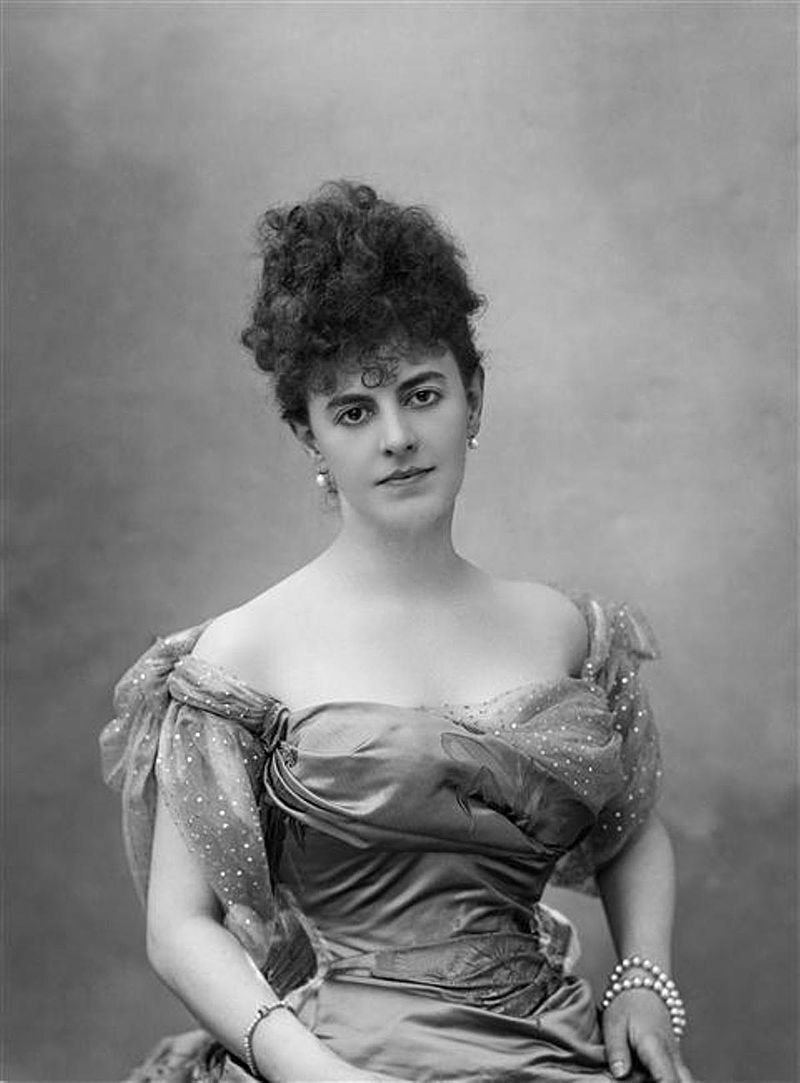
In summer, in my earliest years, we spent a few weeks at Dieppe, at the house of my aunt Greffulhe, aunt Bebeth, another considerable figure whose doings and splendour dazzled my childhood, just as did the axioms and precepts of aunt Albertine[5], called Titine by her disrespectful nephews.
The villa La Case, at Dieppe, stood atop the cliff and commanded an admirable view over the sea. Dieppe was then the fashionable seaside resort, and the villa La Case was the centre of a fashionable and elegant social life in which, of course, I took little part at my age. However, I recall that my cousin Élaine Greffulhe, future duchesse de Gramont, initiated me into the art of tennis, then in its infancy, by throwing balls over the net to me; and the little boy, three or four years old, who gathered up our balls, was Louis de Broglie, future Nobel laureate, who at that time gave little thought to wave theory.
We bathed little, it seems to me, but talked a great deal and ate even more – meals were long and lavish. Aunt Greffulhe, who would sometimes go down into town in a sort of small carriage drawn by swift ponies, was always surrounded by a motley court in which ageing beaux, decayed scholars, foreigners of renown, or unknown painters mingled. She had, whatever happened, the bearing of a queen, but it should be noted that she never ventured either to go shrimping, or to emerge from a bathing-machine, for in those days horses would draw the machines out to the edge of the waves so as to spare the modesty of the ladies from showing the little they did show, all caparisoned and padded as it was, to curious onlookers.
Comte Greffulhe, her husband, appeared but rarely and struck terror around him, which I believe gave him the opportunity to sidestep scenes of jealousy that he well deserved, for this figure, who boasted of himself and whom his entourage made legendary, had notorious weaknesses for the ladies, which caused despair to my aunt, although she would, I believe, have been quite distressed to be the sole object of his repeated favours.
He was a handsome man in the fashion of the day, with the square beard of an Olympian Jupiter, and was at bottom an excellent man, though endowed with a fierce selfishness, adoring women, hunting and objets d'art, and living a royal existence as a spoilt child such as can hardly be imagined nowadays. He was born around 1850, had already as a young man known the last years of the Second Empire, an only son and adored child of the wealthy Greffulhe family, Dutch bankers who had come to settle in France at the beginning of the last century and who had, at once and I scarcely know why, unless it were a natural splendour and elegance, carved out for themselves a leading place in French society.
A son of the maréchal de Castellane (unless it was he himself[6]) had married the beautiful Cordelia Greffulhe – it was on leaving a ball at M. Greffulhe's that the duc de Berry was stabbed. He himself, as a young man, was intimately connected with the prince of Wales, and told me it was he who had informed him of the imminence of the war of 1870, advising him, during a visit he paid him at Sandringham, to return to France. I do not believe, however, that this was in order to fight, for in those days of a professional army the French defeat was sealed before there had been time to mobilise all the goodwill available. On the other hand, he told me, with a certain superb air, showing me the hôtel on the rue d'Astorg, which he contemplated from his study in the concierge's lodge on the far side of the courtyard: "You see that house – well, they ate chicken there throughout the whole siege of Paris." What might seem today, to those who have known ration cards and, for that matter, the pleasures of the black market, a joke in poor taste, was at bottom, for the dear uncle, nothing but nostalgia for a time when armies were commanded by well-bred people who knew what was proper, and who, among other things, would doubtless let slip through the net encircling Paris the weekly omnibus which, from Bois-Boudran, was to bring M. Greffulhe the means of his subsistence.
After the war, he had lived the sumptuous existence of a very wealthy and very elegant young man, quite handsome for the period; he had known resounding affairs, flattering successes, aided it must be said by considerable means, which never hurts, especially, as was several times his case, when approaching society women. But that came later.
In his youth, he was seen about with, among others, a ravishing dancer, Mlle Fiocre, of whom the loveliest of busts remains, signed by Carpeaux, and a son, and to whom a late marriage to a somewhat impoverished and very mature provincial gentleman gave a status that made people forget the foyer de la danse. Another son, alas, was not given him by his wife, the ravishing Élisabeth, aunt Bebeth, for whom he fell after meeting her by chance at some party or other.
One day aunt Ghislaine, a younger sister, came back from lunch and announced that it was being said around Paris that Élisabeth was going to marry a handsome young man nicknamed the Golden Calf, who was said to be a cripple. This was indeed the nickname of the handsome Henri, and it was true that a badly treated sprain, which a little massage at the outset would have cured, had settled in and had created, through laziness on his part, a notorious inability to use one of his arms, which troubled him for the rest of his life. From then on the engagement was official, and he came to pay court, every afternoon, at the quai Malaquais, in a brougham drawn through Paris by two trotters named Brin d'amour and Porte-monnaie, at a speed we no longer know. This young couple, set out for glory in an almost royal splendour – she famed for her beauty and her charm, he for his lavishness, his successes, the splendour of his shoots, the opulence of his existence – was to know a fluctuating destiny, but time passed, and they learned to accommodate each other's faults, which were above all the faults of spoilt children, and which filled society with tales of their disagreements; they nonetheless kept a splendid façade.
Aunt Élisabeth Greffulhe was famed throughout Europe for her beauty; she had a magnificent profile lit by eyes of a jet black, sparkling and laughing, an ideal small head on the loveliest neck in the world, a way of holding herself and of walking that was truly regal even as it was graceful, a conversation brilliant and pleasant without being pedantic, and a crystalline laugh that has remained a charm in the memory of those who knew her.
Marcel Proust has left us a famous portrait of her, under the features of the duchesse de Guermantes in her box at the Opéra.
For one had a "baignoire" box at the Opéra, not a mere loge, which was rather common, and when one had no wish to see Faust or Rigoletto again, one made a gift of it to friends or to somewhat impoverished relations, who in turn used it to do favours of their own. My parents thus inherited two or three times each winter the subscription of the wealthy sister, but on one occasion they paid for a seat for themselves and for me, so that I might remember, they said, having seen aunt Greffulhe descend the staircase of the Opéra, and indeed it was a fine sight.
What would Proust not have written about this incident, and indeed how many anecdotes I could have whispered to him about the life and doings of so many of these figures who peopled both the côté de Guermantes and my childhood, for much later I realised that the Guermantes, Charlus, M. de Norpois, Mme Verdurin, and so on, were the circle of the family whose doings were recounted to me by Céleste, the governesses and the ladies' maids.
It was thus that I lived in the apartments of the famous Palamède de Charlus, alias Robert de Montesquiou, and that I took my first bath in a bathroom he had had fitted out in ceramic with a decoration of blue hydrangeas, a rare luxury at the time, and which moreover functioned only rarely. Aunt Élisabeth took little interest in the young Proust, of whom she told me later, much later, that she had known him well, that he wrote to her frequently, but that she scarcely dared invite him except to the great gatherings known as "lessives" [wash-days], for, she told me, your uncle would have been very astonished to see him at his house.
*
My father's younger brother, Alexandre, was then quite young and most charming, the handsomest figure imaginable, the most agreeable manners, and at the same time a certain sporting inclination for the period made him the most amiable of companions, the youngest of this so wonderfully united and intoxicating family; he had been much indulged by his elder brothers and sisters.
After dazzling me with a ravishing little cart, very well harnessed, and with feats performed on a petrol-driven tricycle, one day we waited the whole of the late afternoon and were given leave to prolong the evening watch until nine o'clock, finally to see appear at the end of the château street the red and green lanterns of the first motor car, in which uncle Alexandre arrived from Paris. The mixture of air and petrol had to be produced by the driver's passenger, blowing air into the carburettor with the aid of a rubber bulb, which over a long journey must have been tiring.
Later the charming Alexandre married Hélène de Brancovan, descendant of the Hospodars and of the emperors of Byzantium, and sister of the famous Anna, comtesse de Noailles, whose talent, wit and conversation, not to mention her beauty for those who liked this rather oriental type, made her sister's charm appear in half-tones; yet I believe that, at bottom, she was more appreciated by truly discerning connoisseurs, for Anna, with her passions, her furies, her sayings and the clamour of her conversation, was a somewhat noisy and jealous star. But she wrote ravishing things, doubtless unfashionable today, and she had real talent.
*
My first communion at Sainte Clotilde in 1902 did not make a very great impression on me, apart from the astonishment caused me by my aunt Greffulhe, that fabulous figure, wishing to be the first to embrace me as I came out of the church.
*
With the naivety of children, I had no inkling of the gravity of my mother's condition; I had always known her to be delicate, and indeed the whole family seemed to enjoy deplorable health, illnesses following one upon another, typhoid fevers, appendicitis, then very much in fashion, and I did not concern myself with the state of my mother's health.
It was a shock when, at the end of June (1906), I was suddenly summoned back to Paris. As the worries were momentarily allayed, I was sent back to Brussels, then summoned again around 15 July, and on 20 July my poor maman passed away.
She was mourned by all, and her charm, her refinement, her intelligence remained for a long time in the memory of those who had known and loved her. It is sad no longer to be someone's child. As soon as these sad ceremonies were over, in Paris and at Pargny, where she had not wished to be buried, but where the opinion of the terrible aunt Albertine, who had decided otherwise, prevailed – later, as it was their mutual wish, I saw to it that these two beings who had loved one another were reunited in the family vault at Chimay – it was thus judged necessary to change our thoughts, and my aunts Élisabeth Greffulhe, Ghislaine and Geneviève, and uncle de Tinan, first took us to Carlsbad, where all this company, who ate too much, believed they ought to go and take the waters; it was then the fashion.
We therefore set off for Carlsbad on 1 August; aunt Greffulhe, who could never do anything like everyone else and loved to travel royally, had had our journey organised by M. Nagelmakers, director of the Compagnie des wagons-lits, with the effect that instead of taking the Carlsbad-Express, which would have carried us directly to that spa town, we had to change at Munich, at Nuremberg and I know not where else, so as to allow for enough sovereign receptions from stationmasters in top hats for our delighted aunt.
When at last, in tropical heat, we reached Carlsbad, she found it quite natural to notice, in the apartment that had been reserved for her, while her sisters had more modest rooms at the end of the corridor, two magnificent baskets of roses which chamberlains had come to deposit on behalf of the emperor of Germany and the emperor of Austria.
*
These were the years when the mirage of the Ballets Russes suddenly burst forth. My aunt Greffulhe had been the fairy godmother who, with a wave of her wand, bestowed on Paris this splendour hitherto unknown. A little letter to the Tsar, she said one day in 1952 to some young friends of ours who had wished to meet this venerable but still celebrated grande dame, and this evocation, in the Paris of forty years later, when even the word Tsar evoked only distant memories, had something unreal and fabulous about it.
*
My sister Anne was still in her most tender years, and at most I could take her on a few walks in the Bois. My aunts were charming but distant: Ghislaine in Brussels, lady-in-waiting to the young queen Élisabeth, to whom she was bound by a tender friendship; Geneviève in Morocco, where her husband[7] was trying to make people forget his time at the ministry of war, which had succeeded in making him hated by decent people, by covering himself in glory at the taking of Taza, where he had been gravely wounded; the famous aunt Greffulhe was slowly ripening in her splendour. At last her mother-in-law had decided to die, which had been expected for a long time, and this delay had caused her son to say to her one day in impatience: "Well, no one dies any more, in this family." And the old lady, having understood what was meant, aunt Élisabeth had at last settled into the magnificent hôtel at 10 rue d'Astorg, whereas until then I had only known her at no. 8 next door, which had been built for the young couple.
There was room on this immense plot, which had been acquired by the Greffulhes at the beginning of the century, had once formed part of the park of the prince de Beauvau, and easily contained all the family's houses, linked together by courtyards and gardens, forming an ensemble known as the Vatican. It was a sort of island in the Paris of the Madeleine, then considered not very fashionable.
The house at no. 10, into which my aunt had just moved, was at last the mother house of this establishment, built in 1784 by the maréchal de Beauvau for his son-in-law the prince de Poix, at the gate of his park, known as the porte de la Ville l'Évêque, the name of the village that once stood on the site of the church of the Madeleine. Later, on this plot acquired at the beginning of the century by the wealthy Greffulhe family, there had risen houses for the marquise de L'Aigle and the princesse d'Arenberg, Greffulhe daughters, and finally investment properties bordering the boulevard Malesherbes and the building of the compagnie de Suez. Aunt Greffulhe entertained superbly there a motley company ranging from the most imperial highnesses to the most celebrated scholars, passing now and then through dubious connections and even notorious swindlers.
Another member of my family who was most charming was my uncle Alexandre, my father's younger brother. He was at most in his forties at that time and had the finest bearing in the world, along with the finest figure. Behind this seductive façade, there was not a great deal hidden, and the dear man led an idle life which consisted in eating excellent meals, for he kept a memorable kitchen of which he took the most diligent care; towards four in the afternoon, except on Thursdays when he went to the cinema, he would go to the Club, where he headed straight for the billiard room.
Like the maréchal de Tallard, of whom Saint-Simon said – in a terse phrase, quoted by grammarians because it depicts the whole man, his glory and his brilliant achievements, without a single adjective – that "his whole art was to excel at billiards", uncle Alexandre was a master of the game, and it was all he did, but he did it well.
In July he would withdraw to Chimay, where he happily spent the summer and autumn, shooting the occasional rabbit in the park, and a few waterfowl by making the daily circuit of the lac de Virelles. His wife, my aunt Hélène, was a delightful person, lively, witty and intelligent, pretty even to those who liked a somewhat exotic appearance; the Greco-Levantine side of the old Brancovan alliances showed through a little in her fine eyes and very dark hair; to my eyes she had far more charm than her sister, the celebrated Anna de Noailles.
She was rather eclectic in her tastes and moved more in a rather special world, doubtless very elegant, headed by the princesse Edmond de Polignac, as musical as music itself, but as sapphic as the goddess Sappho, and which included a certain number of ethereal ladies and rather decadent artists and writers.
Of all the ladies whom Proust frequented – and he did not know so very many, for at bottom his models were built from hearsay – my aunt Hélène was his favourite, although he never described her. He would often come to see her in the afternoon when my uncle was at his club, and he himself told me, much later, that on going down to go out[8] he had often found Marcel Proust in the antechamber, seated on the wood chest, interviewing the butler about details of service or of silverware, which his meticulous mind noted down so as to reuse them in time lost, or else at the Swanns'; and as my uncle did not know him, he would raise his hat to him, a top hat, that is, in passing. For the top hat was still worn in the afternoon and for going to the club.
My uncle Alexandre was so fond of good food that when he had eaten in a restaurant a dish that suited him – and even then some friend had to have pointed it out to him, for he went out little and scarcely ventured into eating houses – he would send his cook there, and would then discuss endlessly with him the ins and outs of the meal and the secrets of the famous dish. He cared little for other kitchens' fare, and I do not recall ever having heard that he took a meal away from home, where he suffered cruelly from his wife's lateness, whom he sometimes awaited a few minutes, seated at table at the appointed hour, sounding with reproach a repeating watch laid before his plate. Proust could have carefully sketched such a character, but I have never found a trace of this couple, charming but so notable, in his work, just as I have never found any resemblance of my aunt Greffulhe or her husband in the duc or duchesse de Guermantes, and very little kinship even with Robert de Montesquiou in that Charlus, who had horrible vices, whereas Montesquiou had none at all.
It was around this time that I sometimes met Proust in the morning, on the sentier de la Vertu, a fashionable walk of the period, which he paced out of pure snobbery, for he detested going out by day and especially to the Bois, on account of his asthma; and I noticed, not without irony, this strange individual who, in the full month of June, wandered about alone in a bowler hat and black coat with an astrakhan collar, a white scarf over his nose. I asked one day who he was, of Jacques de Ganay, who told me: "But surely you know, it's little Proust, who always hopes to dine out with old ladies whom he assassinates, it seems, so maman says, with endless letters."
*
At last the supreme crowning achievement of my hunting career at that time (1922) was my initiation at Bois-Boudran. This is no idle phrase, for it was then one of the most exclusive clubs in the world. Old uncle Greffulhe, who seemed to me thus, though younger than I am now as I write these lines, was an inveterate egotist, but charming to his friends – he had worn out three generations of them – and he invited only a few chosen few, known as the founders, whom he liked to have around him every week from the first of October until the closing of the season. In the old days, every Friday and Saturday were scrupulously reserved for sumptuous shoots on an immense estate: eleven thousand hectares at its largest, amid an unbelievable luxury of cooking, gamekeepers and beaters. He reared thousands upon thousands of pheasants – was it not said that each day required two cartloads of wheat for them? – and this splendour served to amuse six founders, always the same, who had once been the friends of old Greffulhe, then of his own generation, and were now that of their sons. So the chosen few were well aware of the splendour of their privilege, and would not have agreed to shoot elsewhere on those fateful days.
When I re-entered, through a small door, this magic circle, the magnificence had yielded a little to the harshness of the times. The setting remained, like the atmosphere, without equal, but the shoots had lost some of their brilliance, and were sometimes limited to mediocre rabbit shoots; yet so great was the prestige still that, to their great regret, the professional shots such as d'Ayen preferred to sacrifice, for such mediocre days, more sumptuous invitations.
There was less game, perhaps fewer keepers, only Saturday was now devoted to this rite, but the ceremonies continued to be observed: an exquisite lunch whose menu would seem fabulous today, departure in horse-drawn carriages driven by coachmen and footmen in pearl-grey frock coats and top hats, a little dog cart, or phaeton, driven by the master of the house and accompanied by his oldest friend, the rest in a brake. At the meeting point one found loaders in dark blue livery who were the estate's gamekeepers, often old and not very nimble, which infuriated the specialists, who were not permitted to bring their own loaders, become a sort of juggler. This rule was imposed by the old uncle, who had once received a pellet and was very wary on this score.
Thus, when I made my début in this circle, I was given as loader an excellent, trustworthy man whose task was to report to my uncle on my care, my manner of shooting, and so forth. Doubtless the report was favourable, since I was invited again. It was also said that the first time some newcomer appeared, he was placed at the end of the line, where he could not risk shooting the host, and as the reports proved good, he would be moved closer to the centre, and one day, the supreme consecration, would find himself near the master of the house.
These precautions gave great opportunities to the founders, well established in this cosy set-up, to eliminate newcomers of whom they did not approve. This was the case one day, it seems, when they had the perfidy to advise someone in that position to leave behind his guns and a fairly considerable quantity of cartridges, so as to demonstrate clearly – such was their duplicity – the pleasure the fellow would find in being invited again. Then they denounced to Greffulhe the vanity and lack of manners of the individual, to whom the prompt return of his guns and ammunition was the lasciate ogni speranza.
Before the war, even the rule of fidelity was broken only for crowned heads: the king of Portugal, the prince of Wales, the king of Spain had known this honour. Then no expense was spared: the pheasant stores were thrown wide open, to reach the prodigious quantity of birds needed for these hecatombs of three thousand pheasants. The public drummers would beat the call to arms to attract beaters from all the neighbouring villages, and it was said that beneath the white smocks of these modest contributors to the pleasures of the great were sometimes hidden notaries, doctors and even a priest, fascinated by the splendour of the occasion and the spectacle of this slaughter of birds offered up to kings.
This uncle Greffulhe was, on his own, quite a spectacle. All my life I had only glimpsed him; his wife and sisters-in-law had made him into a sort of ogre; when I went to see them, we were shown in through hidden doors, made to pass through secret corridors, for fear of disturbing or meeting this fabulous monster. In that year 1922, one day in autumn, he suddenly took it into his head to see me; my aunt sent me a ukase enjoining me to pass through Bois-Boudran. I stayed there just long enough for a visit, coming from Courances and returning to Reims. On my way back, I crossed paths with a little carriage, called a tonneau, in which this terrible relation sat. He nailed me to the spot with a voice of thunder that uttered my first name, which I did not even suppose he knew; my blood ran cold, which is understandable after thirty years of hidden doors. He was charming, invited me to shoot, and from then on I became a fairly regular guest of these illustrious Bois-Boudran shoots, whose splendour had considerably faded since the war, but which remained a sort of extraordinarily exclusive club. So exclusive that when some misfortune opened up a place, the members of the club arranged matters so that the place should not go to someone they disliked.
While furiously and without the least tact deceiving his gracious wife, treating her most abominably and even coarsely, subjecting her to touchy public humiliations, he never ceased to show her a genuine admiration that persisted through the years and expressed itself in impassioned odes which must, I think, have made people forget the most brutal and painful scenes for the visiting guests. But there must have been compensations, for I believe aunt Élisabeth remained, without great merit for that matter, a model of conjugal fidelity, and bore throughout their long life together apparently odious behaviour and the scandalous display of the innumerable and costly affairs of this impossible but magnificent husband. And she herself doubtless had a few faults, which her cousin Robert de Montesquiou had called "the abominations of the delightful one".
All Paris, indeed the whole world, resounded with the scandals of this household; I never ceased to hear rumours of their probable divorce, to which the various ladies who succeeded one another in this Jupiter's favour devoted themselves with dedication and zeal, but in the end the hidden admiration he had for her, and an attachment she had for him, triumphed over such inclinations. They lived their long life in a stormy union sown with tempests, played up, it must be said, by an interested and voluble public, and moreover without great malice; and at bottom, I believe, they loved one another more than was known, and I wonder whether, during the twenty years she survived him, when she knew less pomp but more freedom, she did not shed a few tears for a way of being that did not displease her masochism.
When I was admitted to the very exclusive circle of founders, he was already an old man in his seventies, but who still cut a fine figure, and whose amorous adventures had narrowed down to a long affair with Mme de la B., whose rather abundant body hair had earned her the nickname la Barbe [the Beard]; which complicated matters for me, because despite everything, and despite the much-dreaded thunderbolts, aunt Élisabeth had set as a condition of my appearing in this so famous circle that I should not take part in the shoots at which the favourite appeared, which took place on the land known as la Grande Commune, an outlying part of the property a few minutes from Bois-Boudran. Now it happened that from time to time the shoot took place on this territory, which caused interruptions in my Saturday invitations.
One day, however, the last of the potentates went back on his promise, and I was invited to la Grande Commune, at the favourite's house. That morning, the whole household, civil and military, butlers, footmen, cooks, kitchen boys, climbed into vans and moved over to the lady's house opposite, who had doubtless demanded my presence in order to humiliate my aunt, whose veto concerning me had vexed her. How did Mme de la B., a well-known society woman accepted in the best circles, come to accept this status as an acknowledged mistress? By what miracle did the rest of society, sometimes so cruel, turn a blind eye to this shocking arrangement?
Sometimes too, by tacit agreement, aunt Élisabeth had the use of Bois-Boudran on Sundays, while her husband and the shooting party flew off to Paris. She would take the opportunity to invite a disparate mixture of goateed scholars in celluloid collars, would-be men of letters, inventors whose future was sometimes brilliant, swindlers of whom one might say as much, sprinkled with fashionable but hardly sporting people, celebrated conversationalists, and astonished neighbours.
[1] Thierry de Montesquiou, father of Robert de Montesquiou, was the younger brother of Napoléon de Montesquiou, himself father of Marie de Montesquiou, princesse Joseph de Caraman Chimay (the parents of the comtesse Greffulhe and the grandparents of Jean de Chimay). Robert de Montesquiou was thus, as is known, the first cousin of the comtesse Greffulhe's mother.
[2] Governess of the king of Rome.
[3] Prince Joseph de Caraman Chimay (1808-1886), grandfather of the comtesse Greffulhe. It was he who acquired the hôtel on the quai Malaquais.
[4] Valentine de Caraman Chimay (1839-1914) married prince Paul de Bauffremont, then prince Georges Bibesco, by whom she had Georges-Valentin Bibesco, husband of Marthe Bibesco.
[5] Comtesse Jean de Montebello, née Albertine de Briey (1855-1930). She was the first cousin by marriage of the comtesse Werlé née Montebello, maternal grandmother of Jean de Chimay.
[6] Indeed.
[7] Charles de Tinan
[8] Prince and princesse Alexandre de Caraman Chimay lived at the time at 31, avenue Henri Martin.