
Pierre Lemaitre: “My novels are the autodictionary of my reading”
Invited by the Société des Amis de Marcel Proust as part of its series of meetings with winners of the Prix Goncourt, Pierre Lemaitre spoke about his discovery of Marcel Proust’s work, the borrowings from Proust in his own novels, his idea of popular literature, his experiences with cinema and the circumstances of his Prix Goncourt. A conversation full of humour, memories and affection for a writer he now regards as an “office colleague”.
Jérôme Bastianelli — Good afternoon, everyone, and welcome to the Maison de Tante Léonie. I am truly delighted to see so many of you here today for this meeting with Pierre Lemaitre. It is part of a series we launched a little over a month ago, in memory of the Prix Goncourt that Marcel Proust won in 1919 for À l’ombre des jeunes filles en fleurs. We wanted to invite winners of the prize to come and talk to us about their work and, more particularly, about their relationship with Proust’s. I warmly thank Pierre Lemaitre for accepting our invitation, and also for the interest he takes in our association, of which he has been a member for several years. Before we begin our conversation, I would simply mention that Pierre will sign his books afterwards, in the orangery in the garden.
After a few words of welcome from Olivier Bariéty, mayor of Illiers-Combray, Pierre Lemaitre takes the floor.
Pierre Lemaitre — I am not very proud to be here! When Jérôme Bastianelli asked me to come, he really had to insist. Since he is a friend, and since this association means a great deal to me, I sacrificed myself. But coming to talk about Proust in Proust’s house, in front of an audience of Proustians, is intimidating enough. And when I learned — naturally, no one had told me beforehand — that Jean-Yves Tadié would be here, I nearly left! I am so afraid of being ridiculous that, if I am, I thank you in advance for not showing it too effusively. So I ask you for a little compassion for the hour ahead. In my opinion, you can expect the worst!
Jérôme Bastianelli — We will try to be kind, you can count on us! My first question is the one I put to Laurent Mauvignier when he came a few weeks ago: how did you discover Proust? I already know your answer, since you were kind enough to tell it in our book Proust pour la première fois. But not everyone here may yet have this reference work on their shelves…
Pierre Lemaitre — I think many readers keep a very precise memory of the circumstances in which they discovered certain books. In any case, I remember very well the day I discovered The Three Musketeers, and the day I discovered La Recherche. I had one huge advantage: I discovered Proust before anyone told me he was difficult. So I didn’t know! I was a very young man, living in Bondy, in Seine-Saint-Denis. I can still see my bedroom perfectly, the bed, the window on my left. I no longer remember how I had come across Un amour de Swann in paperback. I start reading, in bed, and from the very first sentences, the ones that take us into the Verdurin salon, I am gripped. Everything seems extraordinarily easy to me. There is an immediate elective affinity whose nature I do not really understand.
I put the book down and say to myself: I have to buy La Recherche. The next day, I go and buy the Pléiade volumes. It was an enormous expense for me. I had practically no money; I owned perhaps one or two Pléiade volumes that I had been given, but it was absolutely beyond my means. Even so, I bought La Recherche and read it straight through.
I have since learned that it takes about a hundred and thirty hours to read it aloud, in the version recorded by André Dussollier and the other actors. It must have taken me twice as long! In any case, I keep a very vivid memory of the shock that this discovery was.
Jérôme Bastianelli — So it was a shock in your life as a reader, but Proust has also played a part in your life as a novelist. You told me, while we were preparing this conversation, that you had borrowed certain narrative techniques from Proust. There are also, in your books, names of characters that readers of La Recherche recognise. Let us perhaps start with these narrative borrowings.
Pierre Lemaitre — I owe techniques to Proust, but I owe them to so many people! To put it briefly, I would say that my novels are the autodictionary of my reading. We may talk later about popular literature, a label I have claimed ever since my Prix Goncourt. But you have to admit that Lemaitre and Proust are rather an odd couple! When Laurent Mauvignier says that Proust mattered to him, nobody is surprised. In my case, it is more surprising: I write adventure novels.
I have not drawn lessons in narratology from Proust. But certain passages have struck me so deeply that they come back to me spontaneously when I write. For instance, this morning, in my hotel room, I came across a passage from Couleurs de l’incendie again. It was inspired by a scene at the end of Le Côté de Guermantes, the one where Swann tells the duchess that he is seriously ill and will not be able to go to Italy with her. Oriane is stunned. She no longer knows what to do. She cannot find, in her repertoire of social behaviours, the one that would suit the situation.
That indecision had struck me very much. In Couleurs de l’incendie, I imagined a scene that is, of course, very different. A little boy of about ten throws himself from the second floor onto his grandfather’s coffin on the day of the funeral. In the next chapter, the consequences of this event have to be dealt with. The coffin is bloodstained, the burial is interrupted. I wanted the master of ceremonies to find himself in the same state of disarray as the Duchesse de Guermantes. He is so thrown by this catastrophe, which upsets all his professional customs, that he ends up dying of it. He is a sort of Vatel of the undertaking trade!
That said, my text is not an imitation of Proust, still less a parody. But a literary situation that had struck me gave me, years later, a way of telling a story. I believe that when you write a novel, you are exposed to a kind of invisible “rain”: images, words, expressions, encounters, books. And all of it ends up resurfacing. A novel is simply making something new out of something old. I do not believe in inspiration that falls from the sky and that you only have to set down on paper. Like Hugo, I believe in perspiration!
One day, in one of my novels, I described a cavalry officer who moved his head like a parrot. I wondered where that parrot could possibly have come from. I do not see many of them in my personal relationships! Months later, I remembered Stephen Crane, in The Red Badge of Courage, where a character moves his head like a wet parrot. I had completely forgotten that reading, but the image had stayed. The same thing happened to me with Proust. Do you remember the restaurant in Balbec, in À l’ombre des jeunes filles en fleurs, whose windows make him think of an aquarium? One day, the image of the aquarium came back to me as I was writing. So I put Marcel Proust in the book’s acknowledgements. Of course, I do not think Proust registered a copyright on the word “aquarium”! But since the image came to me from him, I wanted to thank him.
So in these lists of acknowledgements you find Proust, Stephen Crane, but also Eddy Mitchell. And why not? In the making of a novel, an idea that comes to you from an Eddy Mitchell song can play exactly the same role as an image from Proust. Besides, these lists have sometimes been misunderstood. Some readers thought they were my literary admirations. Not at all! There are even, among these names, people I detest! Proust nevertheless holds a special place. He is one of the writers I quote most often.
And then, while preparing for this meeting, I had a reassuring thought. Deep down, Proust and I have something in common: the Prix Goncourt. So I am entitled to regard Marcel Proust as an office colleague! That completely took away my inhibitions.
Jérôme Bastianelli — There are also the names you borrow directly from Proust. I have brought Alex, a crime novel I particularly recommend, with its Russian dolls of suspense: each time you think you have solved the mystery, another appears, and then another. Yet in it we meet a Jupien and a Cottard, two names well known to readers of La Recherche. This time, you cannot claim it is unconscious!
Pierre Lemaitre — Absolutely. In Miroir de nos peines, the third novel of my trilogy devoted to the interwar years, I took a whole series of names of Proust’s secondary characters: Thirion, Gibergue, Buroc, Pipereau, Varenbonde, Burnier, Osler, Bornier, Loiseau, Beaucerfeuil, Aubergeon…
In fact, I always find it rather hard to come up with names for my secondary characters. For the main characters, I think a great deal. But for the others, I like to have a system. For this trilogy, I said to myself: I will take all my secondary names from Proust. So, in a way, I do my shopping in his books; it’s practical! But that does not mean there is any correspondence between Proust’s character and mine. I am simply looking for a name that fits. If Proust supplies it, why would I look elsewhere? For the following tetralogy, I did the same thing with Simenon. Given the order of my admirations, that was fairly logical. May I say a word about popular literature? Because it is somewhat connected with what I have just been describing.
Jérôme Bastianelli — Of course!
Pierre Lemaitre — When I received the Prix Goncourt, in 2013, Bernard Pivot declared: “We have crowned a great popular novel.” Well, fine, why not; I wasn’t going to file a complaint! But then journalists began asking me what popular literature was. And I ended up discovering that I had a theory on the subject without knowing it.
The great difference between Proust and me is that he is a writer, whereas I am a novelist. It is a distinction already made by Raymond Chandler: a writer is someone who produces writing; a novelist is someone who tells stories.
Of course, that does not prevent Proust from telling stories, nor Lemaitre from sometimes playing, very modestly, at being a writer. But I am above all attached to the ordering of the narrative. I belong rather to the school of Simenon. My idea of popular literature is a literature that can bring together different readers.
Take Au revoir là-haut. A reader of sixteen or seventeen must be able to read it at face value, simply to find out what is going to happen to the characters. As when I read Alexandre Dumas: I wanted to know what d’Artagnan was going to do, how Edmond Dantès would get out of it. That is the first circle, the circle of adventure.
A second reader, perhaps a little more seasoned, may take an interest in the novel’s political and social underpinnings. Why do these soldiers, who gave their youth to defend their country, no longer find their place in society when they come back from the war? It is a question Aragon had already addressed in Aurélien.
And then there is a third circle: the readers who will recognise, here a Jupien, there a Cottard, elsewhere an image borrowed from Proust. They will understand that I am winking at them. It is a very important pleasure of writing for me. Because, you know, being a novelist would be a wonderful job if it weren’t for the readers! You spend eighteen months, sometimes more, alone with your characters, without knowing who will read the book or how it will be received. You have to be a little obsessive to bear that. I am very reasonably obsessive, so I more or less manage! So, during all that time, you also have to know how to give yourself some pleasure. And these little winks are part of it. It is a way of greeting unknown friends, people who have shared the same reading, the same emotions. We do not know one another, but we can recognise one another through a sentence, an image, a name.
In my latest book, I did something silly: I dedicated it “to Hugo and Dumas, affectionately”. What had I done! Some people wrote: “He certainly thinks highly of himself!” You have to explain everything to them!
What I meant by that “affectionately” is that the relationship we have with the writers we love is not only intellectual. It is emotional. Proust is part of my life. Whole passages come back to my memory without my looking for them. They have become inscribed in me. That does not mean I agree with everything he wrote. There are things that bother me, notably certain remarks about Jews. If we meet up there, we will have a few things to sort out! But that does not prevent affection. I do not claim to be a specialist in Proust, or in Dumas, or in Simenon. I simply owe them part of what I am.
Jérôme Bastianelli — Since you mention your disagreements with Proust, I would like to ask you about the political and social dimension of his work. You make no secret of your convictions as a man of the left. The same goes for Annie Ernaux, who, after receiving the Nobel Prize, expressed her admiration for Proust while reproaching him for a certain lack of social awareness. She cited in particular a passage in which Proust compares the gaze of Françoise, Tante Léonie’s servant, to the gentleness of a dog’s. Do you share this criticism?
Pierre Lemaitre — I was very surprised by that statement. All the more so as I greatly admire Annie Ernaux. To write Le Silence et la Colère, which deals among other things with abortion in the 1950s, I went back several times to Happening, which for me is a foundational book on the subject. And we share another, more secret debt: the one we owe Pierre Bourdieu. It is thanks to Bourdieu that I became a writer.
But on Proust, I do not agree with her at all. I would actually very much like to discuss it with her. Her criticism would be admissible if Proust were systematically harsh towards the working classes and benevolent towards the aristocracy or the bourgeoisie. But it is quite the opposite: in Proust, everyone gets what’s coming to them! I do not have the impression that he favours any social category. On the contrary, he addresses to each of them criticisms that seem to me sociologically very pertinent.
I would not say that Proust is a sociologist, but the sociological dimension of his work seems to me indisputable. What particularly interests me is not only the way he describes the different social classes, but the way he observes their interactions. Take Swann, for example, and his taste for women who might be called vulgar, the little laundresses… It is these movements between milieus, these attractions, these contradictions that fascinate me. As for this business of Françoise’s dog-like gaze, I do not see why one should necessarily read contempt into it. I have a little dog. When I got her, I told her she had cow’s eyes. Because cows have a very particular gaze, and to me it was a compliment! I don’t know how the little dog took it, but in my mind it was very appreciative! Perhaps Annie Ernaux misread it. I hope so.
Jérôme Bastianelli — Let us now talk about cinema. Several of your novels have been adapted, and you yourself took part in some of the adaptations. Proust, for his part, has inspired several films, notably those of Volker Schlöndorff, Raoul Ruiz, Nina Companeez and Chantal Akerman. Do you think La Recherche can really be adapted for the cinema?
Pierre Lemaitre — I have always had strong reservations on this question. It ties in with my somewhat debatable distinction between writer and novelist. Adapting a novelist is not too difficult. Adapting a writer is much more complicated. There is something in Proust that I cannot see how to translate into the grammar of cinema.
Take Un amour de Swann. You can make it the story of a jealousy. But what makes this story extraordinary is the way Proust tells it. I remember the moment when Swann discovers his jealousy as an illness, but at the same time feels that his life has become more interesting. It is a prodigious idea! How can you show that in a film? Unless you have the character speak the thought, but then it is no longer a thought.
I believe you can make evocations of Proust, but not really adaptations. The depth of his writing slips through your fingers as soon as you try to reduce it to a succession of scenes. I was not very convinced by Alain Delon as Charlus. On the other hand, Jeremy Irons as Swann appealed to me much more. So there are occasional successes. But, fundamentally, the narrative means of cinema seem to me far more compatible with Simenon than with Proust.
Jérôme Bastianelli — And your own experiences of adaptation? How did things go, notably with Albert Dupontel for Au revoir là-haut?
Pierre Lemaitre — It was a bit chaotic at the beginning. I wanted to hang on, to keep a certain control. And then I very quickly understood that Albert Dupontel did not need me!
I did insist on having my name in the credits, which allowed me to scoop a César. So I am the only Goncourt winner who is also a César winner! For someone who failed his school-leaving certificate, it is a rather belated revenge, admittedly, but revenge all the same!
Albert had to turn a novel of five hundred and thirty pages into a two-hour film. So an enormous amount had to be cut. He needed to test his ideas, and I served as his punching bag. But in exchange for a César, I am happy to be a punching bag as much as anyone likes!
I think he made a wonderful film. When I saw it for the first time, I was so moved that I told him: “I am sure you have made a classic of cinema.” And I still think so.
Then I adapted Couleurs de l’incendie myself, which Clovis Cornillac directed. I wanted to make a Tintin-style adventure, with cars, trains, trips to Berlin, a heroine who gets into the offices of the Wehrmacht and whom you wonder whether she will come out alive. I think Clovis understood that intention very well.
For Trois jours et une vie, I wanted a “Chabrolian” film, and that is exactly what Nicolas Boukhrief made.
And then there were some rather less happy experiences. I had written a series based on Cadres noirs, a novel about unemployment among older workers. I have the impression that the writing was not bad, but the direction, for its part, undeniably was. That experience taught me that once you hand a novel over to cinema or television, you have to accept that it partly escapes you. From then on, I decided to let go. There is an idea in Taoist philosophy that I like very much: to hold on, you have to let go. If you absolutely want to control everything, you end up being crushed.
Jérôme Bastianelli — We were talking about Au revoir là-haut. Perhaps this is the right moment to show us what you made out of Proust.
Pierre Lemaitre — Let me explain a little. In Au revoir là-haut, there is a banker called Marcel Péricourt who goes on to have a whole adventure with his son-in-law, who married his daughter for money. I needed to show the character’s social importance. He is a man of sixty, a considerable man, a great banker of the 1930s.
So I decide to write a scene in which he runs into his son-in-law at the Jockey Club, a club the latter would never have entered without the blessing of his father-in-law.
And then I remember a scene in Proust, in Mme de Villeparisis’s salon, I believe, where the Duc de Guermantes makes his entrance. I went back to look for the passage. I am going to read it to you, then I will show you what I did with it.
Pierre Lemaitre then reads this passage from Le Côté de Guermantes:
Turning upon the many people who surrounded the tea table the affable, mischievous gaze, slightly dazzled by the rays of the setting sun, of his small round pupils set in the eye exactly like the “bull’s-eyes” that the excellent shot he was knew how to aim at and hit so perfectly, the duke advanced with a wondering, cautious slowness, as if, intimidated by so brilliant a gathering, he were afraid of treading on the dresses and disturbing the conversations. A permanent smile of a good, slightly tipsy King of Yvetot, a half-opened hand floating, like a shark’s fin, beside his chest, which he let be pressed indiscriminately by his old friends and by the strangers who were introduced to him, enabled him, without having to make a single gesture or interrupt his good-natured, idle and royal round, to satisfy everyone’s eagerness, murmuring only: “Good evening, my good fellow”, “good evening, my dear friend”, “delighted, Monsieur Bloch”, “good evening, Argencourt”, and, close to me, who was the most favoured once he had heard my name: “Good evening, my little neighbour, how is your father? What a fine man!” He made great demonstrations only for Mme de Villeparisis, who greeted him with a nod, taking one hand out of her little apron.
I loved that scene. I could see the duke perfectly, passing among the guests, giving his hand to be kissed…
And then it seemed to me that there was a second, similar scene in La Recherche, perhaps in Sodome et Gomorrhe, where the one passing among the guests in this way is no longer the duke but Charlus. He does more or less the same thing: you have the impression he is holding out his ring to be kissed.
So I thought it would be good to bring the two together a little: Proust’s text and Charlus’s behaviour. Here is what I wrote. For what it’s worth!
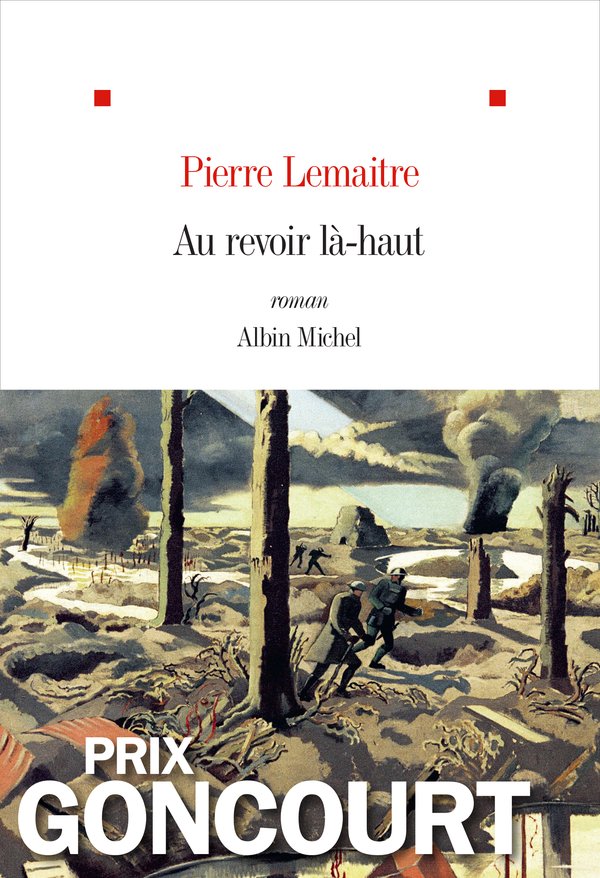
Pierre Lemaitre then reads a passage from Au revoir là-haut:
Monsieur Péricourt had entered the room at the Jockey with a slow, good-natured step. He pretended not to have noticed any of his son-in-law’s manoeuvres and filed this occasion away among the debts to be repaid. He passed between the tables, holding out here and there the limp hand of a benevolent monarch, dropping the names of those present with the nobility of a doge. “Good day, my dear friend, Balanger”, “Ah, Frappier, you are here”, “Good evening, Godard”, venturing witticisms in keeping with his station: “Why, it’s Palamède de Chavigne, if I am not mistaken.” And when he came level with Henri, he merely lowered his eyelids knowingly and continued his crossing of the room to the fireplace, towards which he held out both hands, wide apart, with exaggerated satisfaction.
There, that is a small example of what I amused myself doing. It is a tribute, and also a wink. I imagine that Proust’s readers, coming across this passage, say to themselves: “Well now, that’s not entirely a coincidence! He must have done it a bit on purpose!” Well, yes, I did it on purpose!
Jérôme Bastianelli — Thank you very much; that was most convincing. My last question is also one I put to Laurent Mauvignier a few weeks ago. We know that when Proust learned he had won the Prix Goncourt, he is said to have simply replied, “Ah, is that all?”, before declaring that he did not want to see anyone. And you, how did it go? Were you expecting it?
Pierre Lemaitre — The Prix Goncourt of 2013 is obviously no longer that of 1919. And then Proust was up against Roland Dorgelès’s Wooden Crosses. I was up against a few thoroughly estimable colleagues. I do not think one can consider that the Prix Goncourt necessarily rewards the best book of the year. In 2013, I think one of the good books of the year was crowned. But there were others.
The Goncourt depends on literary parameters, of course, but not only. And above all, it goes beyond the person who receives it. In the year after the prize, they take you everywhere. It is a bit like Miss France, except that you don’t show your knees!
I remember, for example, a dinner at an embassy where, throughout the meal, the ambassador called me “our Goncourt”. “Our Goncourt thinks this”, “our Goncourt is going to tell us that”… At one point I asked his aide, who was sitting next to me: “Do you think that fellow knows my name?” He replied: “No, not at all!” But in the end, the ambassador was right. It was not Pierre Lemaitre he was receiving, it was the Goncourt of the year. And that is very different.
Proust, for his part, really wanted that prize. He had worked to get it, he had schemed, he had even committed a few base acts, I believe…
Jérôme Bastianelli — I would not go so far as to say that.
Pierre Lemaitre (turning to Jean-Yves Tadié, seated in the front row) — No? Monsieur Tadié, did Proust commit base acts or not?
Jean-Yves Tadié — Hmm, I shall follow my president…
Pierre Lemaitre — Ah, what caution! As for me, at any rate, I committed no base acts. I was an outsider. It is one of the great strokes of luck in my life: I have often been underestimated. So I arrive without anyone seeing me coming, and sometimes I scoop the pot.
I had written seven or eight crime and noir novels. Au revoir là-haut was my first real novel outside crime fiction. I was not a natural candidate for the Goncourt. Writers from crime fiction who have won the prize are extremely rare, even if before me there had been Jean Vautrin, with Un grand pas vers le Bon Dieu.
Simenon, for his part, really had wanted the Goncourt. He had written Le Testament Donadieu, a great Balzacian novel, in the hope of winning it. But the Académie Goncourt would not have him. In 1937 it even crowned Charles Plisnier, another Belgian, for a collection of short stories! That tells you how unwilling they were to give the prize to an author of detective novels. So I had no illusions whatsoever.
There are not many events in life of which one can say that they change everything instantly. There is love at first sight, a heart attack and the Goncourt. That is about it, really! As far as heart attacks and love at first sight went, I had already had my share. The Goncourt was all that was left! And indeed, it changed my life. All the more so because I was not expected. For some writers, the Goncourt appears as the natural consecration of a body of work. When Laurent Mauvignier received it, I almost thought he had already had it! It is rather the same with Éric Vuillard, whose work I admired enormously. I was in Arles when he received the prize, and I was wild with joy, even though I did not know him. And I think it a pity, for the Goncourt’s own roll of honour, that Emmanuel Carrère never won it.
But in my case, it was very different. No one had seen me coming. The prize therefore turned my life upside down all the more profoundly because nothing destined me to receive it.
Jérôme Bastianelli — Thank you very much, dear Pierre. We would still have many questions to ask you, but we must also leave everyone time to meet you and have your books signed.
Pierre Lemaitre — I would like to thank you for being here and for your generosity. You did not boo me, and I am very happy about that! I was delighted to come to this magnificent house and to see again my unknown friends of the Société des Amis de Marcel Proust. Keep supporting this fine association, which does such useful work. Thank you all!